More About This Card
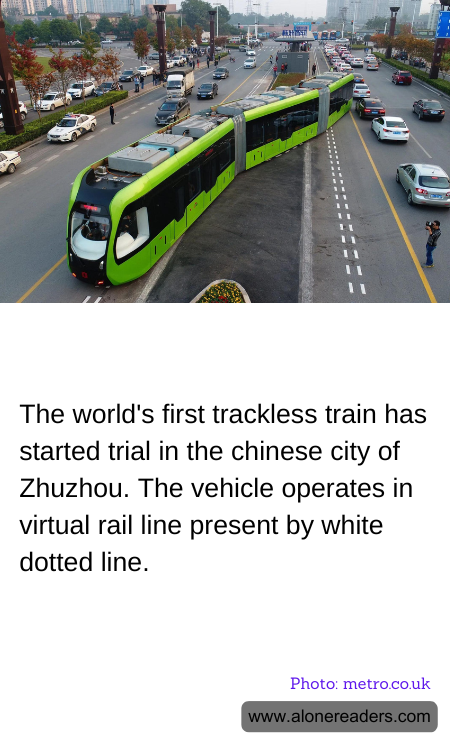
In the bustling city of Zhuzhou in China, a revolutionary development in public transportation has been unveiled as the world's first trackless train began its trial runs. This innovative vehicle, designed by CRRC Zhuzhou Institute Co. Ltd, marks a significant leap in transport technology, combining the functionality of traditional trains with the versatility of buses.
Dubbed as an Autonomous Rail Rapid Transit (ART), this trackless train doesn't rely on physical rails. Instead, it follows a virtual track represented by a series of white dotted lines painted on the asphalt. This pioneering system uses sensors and sophisticated navigation technology to adhere to its route, maneuvering through city streets with the precision of a train, while maintaining the flexibility to navigate around obstacles like a bus.
Spanning about 30 meters in length and capable of accommodating up to 300 passengers, the ART offers a cost-effective and environmentally friendly alternative to subway or tram systems. The construction costs for this system are significantly lower than those for traditional city rail systems, mainly because there is no need to lay down physical tracks or to develop extensive infrastructure. Furthermore, since the trackless train is powered electrically, it contributes to reducing the carbon footprint, aligning with global efforts to fight climate change.
The trial in Zhuzhou serves not only to test the functionality and efficiency of the ART system but also to evaluate passenger response to this new mode of transportation. With a design that allows for rapid reconfiguration of routes and frequencies based on real-time traffic data and passenger demand, the trackless train could revolutionize urban transit planning.
If successful, the implementation of such trackless trains could transform public transportation networks in other cities worldwide. By reducing dependency on more costly and rigid rail constructions, cities could rapidly expand and adapt their public transport systems in a cost-effective and environmentally sustainable way. The trackless train in Zhuzhou might just be the first step towards a future where flexible, efficient, and advanced public transportation systems become the norm in urban environments around the globe.