More About This Card
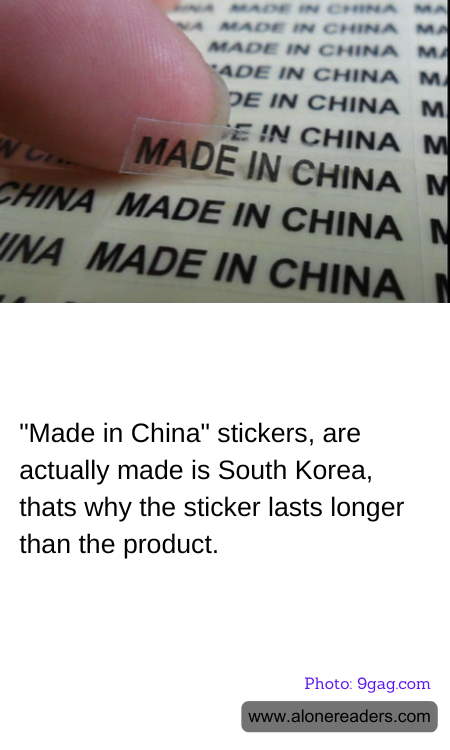
In the complex web of global manufacturing, it's fascinating to trace where products and their components originate from—and sometimes, the irony provides both humor and insight. A particular curiosity is found in the realm of "Made in China" stickers. Widely known as identifiers for products made in China, these small stickers themselves, surprisingly, are not always produced in China. Instead, many of these durable labels are manufactured in South Korea.
Why, then, would a sticker that says "Made in China" be produced in South Korea? The answer lies in the realms of manufacturing specialization and economic efficiency. South Korea has established a niche in producing high-quality adhesives and printing materials, which include stickers and labels. The durability of these stickers is noted to sometimes surpass that of the product they are labeling, a statement that highlights the quality of South Korean adhesive products while ironically commenting on the perceived quality of some goods produced in China.
This situation underscores a broader trend in global manufacturing: the international division of labor. Countries often specialize in producing certain goods or materials, then export them to other nations. China, known for its vast manufacturing capabilities, often imports these high-quality materials from South Korea for use in various products, including the seemingly trivial but essential product labels.
The irony of the "Made in China" stickers also touches on consumer perceptions and global trade dynamics. It hints at the complexity behind product origins, where multiple countries may contribute to a single product. As global trade continues to weave intricate connections between countries, products labeled as being from one place might contain materials or parts sourced from around the globe, challenging our understanding of provenance and quality.
This scenario is a lens through which to view globalization: a world where products are less and less about where they are made, and more about the collaboration across borders. It not only changes how we perceive the products but also highlights the necessity of understanding the global interdependencies that shape our economy and consumption patterns.