More About This Card
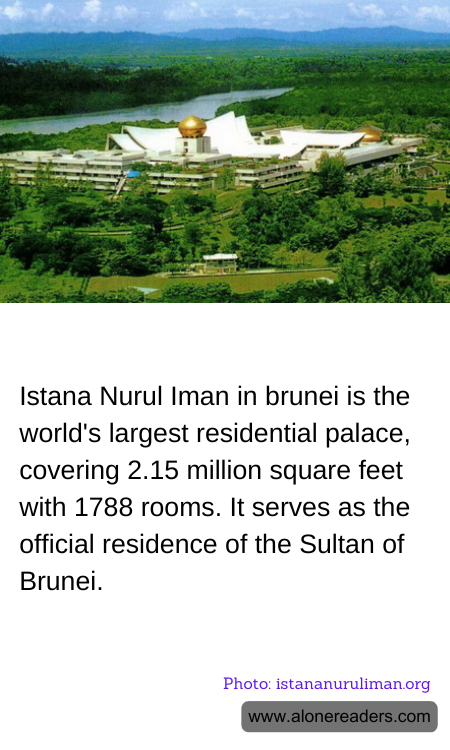
The Istana Nurul Iman palace, positioned in the tiny yet wealthy nation of Brunei, holds the title as the world's largest residential palace. Encompassing an astounding 2.15 million square feet, this grand structure features 1,788 rooms, making it a marvel of architectural grandeur and opulence. As the official residence of the Sultan of Brunei, Sultan Hassanal Bolkiah, the palace serves not only as a home but also as a seat of the nation’s government.
Constructed in 1984 at an estimated cost of over $1.4 billion, Istana Nurul Iman, which translates to 'Palace of the Light of Faith,' was designed by the Filipino architect Leandro Locsin, who is renowned for his use of traditional Islamic and Malay architectural elements. This design philosophy is evident in the palace's lavish interiors that include gold-plated ornamentation, fine silk carpets, and an extensive collection of high-value artworks.
Apart from its residential purposes, Istana Nurul Iman is significant for its role in national and Islamic festivals. Notably, the palace opens its doors to the public during the annual Hari Raya Aidilfitri celebrations, a major Muslim festival marking the end of Ramadan. During this open house, tens of thousands of Bruneians and tourists alike flock to the palace, where they are welcomed by the Sultan and his family, a gesture symbolizing his benevolent leadership and the nation's communal spirit.
The palace’s extensive facilities include a mosque that can accommodate 5,000 worshippers, making it not only a private residence but also a key religious center. It also houses a banquet hall that can seat up to 4,000 guests, a testament to its capability to host large-scale national and international events.
In a contemporary context, Istana Nurul Iman stands as a symbol of Brunei's cultural identity and its monarchy’s influence. It embodies the fusion of modern statecraft and traditional Bruneian values, demonstrating the small nation's considerable economic wealth and its place on the global stage. Scholars and tourists alike admire the palace for both its scale and its embodiment of Bruneian culture, making it a critical landmark in the Southeast Asian region.