More About This Card
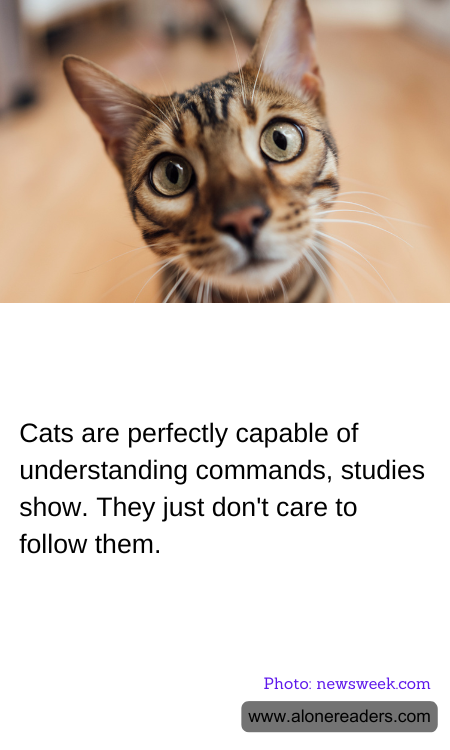
Cats are known for their independent and sometimes inscrutable nature, leading many to believe they are less trainable than dogs. However, recent studies have shown that cats are indeed capable of understanding human commands; they simply choose not to follow them as obediently as their canine counterparts might.
Researchers have found that cats have evolved to communicate effectively with humans and can understand a range of words and tones in a similar way to dogs. For instance, a study conducted at Sophia University in Tokyo found that cats recognize their owners' voices but often choose not to respond in a visible way. This behavior is not necessarily an indication of a lack of awareness or intelligence, but rather a display of their evolutionary traits. Cats are solitary hunters and, unlike dogs who evolved as pack animals relying on social structure and obedience for survival, cats use communication primarily to manipulate their environment to their advantage rather than to build social bonds.
Moreover, cats also show a significant capacity for learning through observation and can pick up what is desirable behavior in certain situations, particularly when it benefits them. For example, many cat owners can attest to their pets understanding commands like “no,” although they might only occasionally adhere to these commands when they deem it beneficial. This selective hearing is often perceived as stubbornness or aloofness, but it might also be seen as a sign of their intelligence and independent spirit.
Behavioral training with cats, therefore, requires a different approach than dog training. Positive reinforcement tends to work best, as cats are more likely to respond to rewards than to punishment. Patience and consistency are key, as is creating a rewarding environment where following a command is more appealing than ignoring it.
In conclusion, while cats may often appear indifferent to human commands, this should not be mistaken for a lack of understanding. Instead, it is part of their nature as independent animals. By leveraging the right techniques, cat owners can engage with their pets in ways that respect their autonomy while gently encouraging the desired behavior, fostering a relationship that is based on mutual respect and understanding.