More About This Card
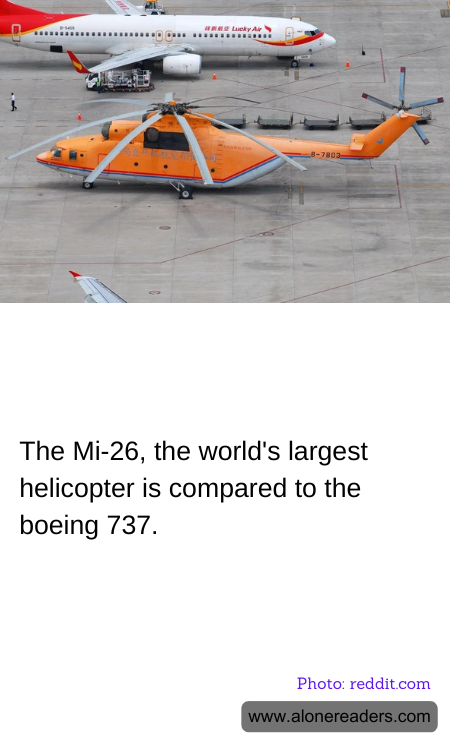
The Mi-26, often referred to as the "flying giant," stands out as the world's largest and most powerful helicopter ever to go into serial production. Developed by the Soviet Union's Mil Moscow Helicopter Plant and first flown in 1977, this helicopter was designed for transporting heavy machinery to remote and inaccessible areas. What makes the Mi-26 particularly noteworthy is its sheer size and power, often drawing comparisons to the Boeing 737, a staple in the commercial aviation industry.
In terms of physical dimensions, the Mi-26 dramatically overshadows typical helicopters. It is approximately 40 meters in length with a rotor diameter of 32 meters, making its rotor disc larger than many entire helicopters. This giant can lift up to 20,000 kilograms of cargo inside its cavernous hold or on an external sling, which is nearly equivalent to carrying another large helicopter or two standard city buses. In contrast, the Boeing 737, particularly the Next Generation models like the 737-800, measures about 39.5 meters in length, showcasing a wingspan of 35.8 meters. This comparison highlights how unusually large the Mi-26 is for a helicopter.
From a performance standpoint, the Mi-26 is equipped with two D-136 turbo-shaft engines, each capable of delivering about 11,400 horsepower, powering it to carry hefty loads over significant distances. The Boeing 737, depending on the model, is powered by CFM International CFM56 or LEAP-1B engines, which are designed for fuel efficiency and noise reduction, essential attributes for commercial passenger jets that typically carry between 85 and 215 passengers.
One of the most interesting aspects of the Mi-26 is its vast range of utility. It has been employed across various sectors including construction, where it is used for airlifting heavy equipment, in disaster relief operations, transporting large amounts of emergency supplies, and even in firefighting missions where it can carry massive water tanks. The Boeing 737, although predominantly a commercial aircraft, has also seen diverse applications including as a cargo transporter, corporate jet, and in military adaptations like the P-8 Poseidon maritime patrol aircraft.
Despite their differences in primary function and operation — one as a heavy-lift cargo helicopter and the other as a medium-range passenger jet — both the Mi-26 and the Boeing 737 symbolize pinnacle achievements in their respective fields of aviation. Each demonstrates the incredible advancements in aerodynamics, engineering, and versatility, serving indispensable roles in both civilian and specialized sectors around the globe. These aircraft not only show the stretch of human ingenuity but also how aviation continues to evolve and adapt to meet various demands across different terrains and missions.