More About This Card
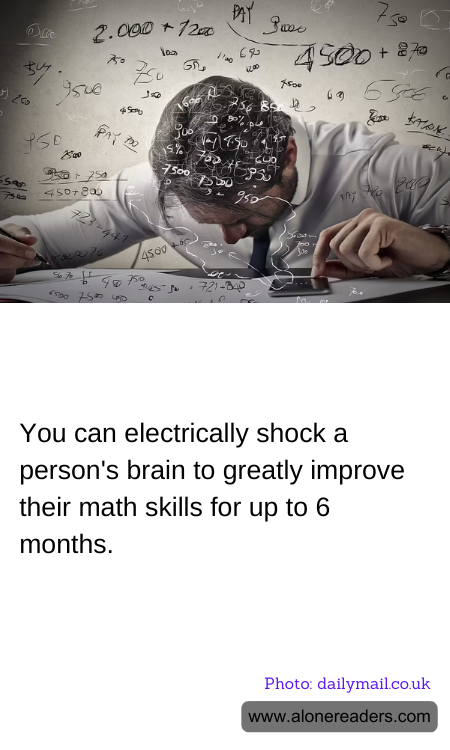
The human brain, with its complex and intricate connections, continues to surprise scientists with its adaptability and potential. One of the more fascinating demonstrations of this is the study in neurostimulation—specifically, how applying electrical currents to the brain can enhance cognitive functions, including mathematical abilities. This method, known as transcranial direct current stimulation (tDCS), has shown promising results in improving math skills in adults, with effects that can last for up to six months.
tDCS works by sending low levels of electrical currents through electrodes placed on the scalp. This flow of electricity is thought to stimulate neural activity, making brain cells more or less likely to fire. This modulation can enhance cognitive performance and has been tested in various applications, from treating depression to boosting creativity. However, it is its potential in enhancing numerical proficiency that has garnered significant attention.
Research has pointed out that stimulating the parietal lobe, a region of the brain associated with processing numbers, can lead to better performance in solving arithmetic problems. In one particular study, participants who received tDCS sessions over the course of five days showed improved capabilities in learning and retaining mathematical knowledge when compared to those who received a placebo treatment. Remarkably, these improvements were not fleeting. Follow-up testing showed that the enhancements in math skills persisted for up to six months after the initial electrical stimulation.
Further studies delve into the mechanics behind this phenomenon, suggesting that tDCS may enhance the brain's plasticity, or its ability to change and adapt in response to new information or experiences. This plasticity is crucial when learning new skills, including math. The electrical stimulation appears to prime the brain for learning, making it more amenable to absorbing and processing numerical information.
Yet, despite the promising results, the application of tDCS in learning and brain enhancement is still under rigorous investigation. Questions around the long-term safety, the ethics of "brain boosting," and the variability of effects between individuals are central to the ongoing debate. Moreover, other factors such as the individual's inherent mathematical abilities, their motivation, and the teaching environment can all influence the effectiveness of this method.
In essence, while the prospect of enhancing brain function through electrical stimulation sounds futuristic and exciting, it also throws open a host of scientific, ethical, and practical questions. As research progresses, it may not be long before targeted neural stimulation becomes a part of standard educational practices, offering a powerful tool to support learning and cognitive development. Nonetheless, it is crucial to proceed with caution, ensuring that such interventions are safe, ethical, and equitable.