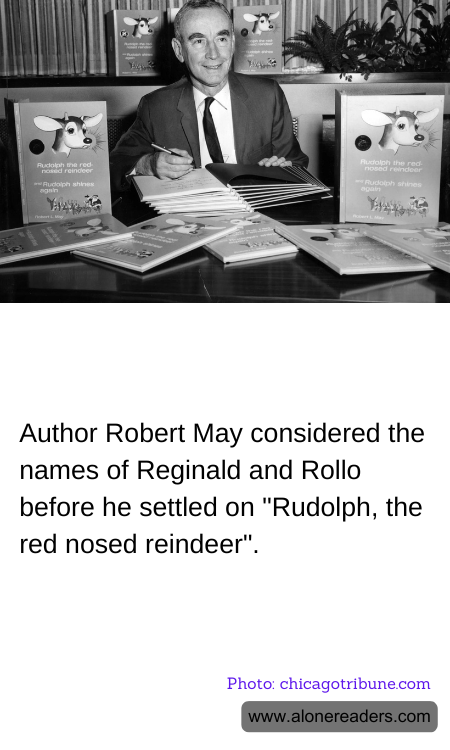
When Robert L. May sat down to write a Christmas story in 1939, he probably didn’t expect that his creation would become one of the most famous holiday characters in the world. Working for Montgomery Ward, May was tasked with creating a book that the store could give away to shoppers as a promotional gimmick. This assignment led May to brainstorm a series of names for his reindeer protagonist, a character whose shiny red nose would eventually light up the pages of his story, and later, the hearts of millions around the globe.
Before settling on the now-iconic name "Rudolph," May considered several other options for his reindeer, including "Reginald" and "Rollo." Each of these names carries its own connotations and style, but they didn't capture the essence of the character May was envisioning. "Reginald" might have sounded a bit too regal and stiff for a lovable underdog, while "Rollo" could be perceived as overly playful or whimsical. In his quest for the perfect name, May sought a balance that would resonate with both an air of uniqueness and a touch of endearment.
"Rudolph," with its soft consonants and gentle rhythm, ended up fitting the character perfectly. It sounded distinctly different from the traditional names of Santa Claus’s other reindeer, such as Dasher, Dancer, Prancer, and Vixen, which helped Rudolph stand out. Moreover, it carried a certain warmth that seemed to echo the character’s eventual narrative of overcoming rejection and harnessing his unique trait (his glowing red nose) to lead Santa's sleigh and save Christmas.
The decision to name the reindeer "Rudolph" proved to be a pivotal one. After the story's release, Rudolph the Red-Nosed Reindeer became a sensation. The original booklet was a hit, and Rudolph's story was later adapted into songs, TV specials, and movies, cementing his place in Christmas lore. The tale of Rudolph, a once overlooked reindeer who turned his peculiarity into his greatest asset, continues to resonate as a message of hope and acceptance, illustrating how our differences can be the very thing that makes us special.
In the end, the name "Rudolph" was not just a label but a symbol of triumph and individuality, a reminder to children and adults alike that everyone has something unique to offer, no matter how unconventional it may seem. Through Rudolph, Robert May not only crafted a character but also a lasting legacy of celebrating differences and embracing the unexpected.
