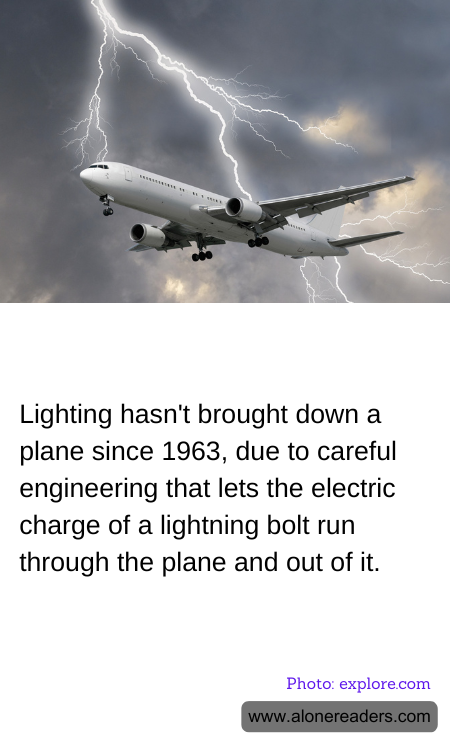
Lightning strikes are a spectacular phenomenon, eliciting awe and fear, but thanks to modern engineering marvels, they no longer pose a significant threat to commercial aircraft. It's a reassuring fact that there has not been a lightning-induced plane crash since 1963. This incredible safety record is a testament to the advances in aviation technology, particularly in the design and construction of aircraft.
Aircraft are designed with lightning protection as a core feature. The outer skin of most planes is primarily made of aluminum, which conducts electricity very effectively. When lightning strikes an aircraft, the electric charge typically hits the aluminum exterior, travels through the fuselage, and exits, often without causing any significant damage. This method of channeling the electrical energy safely through and out of the plane is known as the 'Faraday cage' effect, named after the 19th-century scientist Michael Faraday who invented the first system to block electromagnetic fields.
The structure isn’t the only part of the aircraft designed to handle lightning. Critical systems, including the fuel tanks and electronic navigation instruments, are also shielded against electrical surges that a strike might cause. The materials and pathways used ensure that the lightning's charge does not linger but is instead quickly and harmlessly redirected.
Continuous advancements in material sciences have also played a crucial role in enhancing safety measures. Composite materials, which are increasingly used in modern aircraft, do not conduct electricity as well as aluminum. Therefore, engineers embed these materials with a conductive mesh or layers that can safely transfer the electric current without compromising the integrity of the aircraft's structure.
Moreover, rigorous testing is a critical component of aircraft design. Before any commercial aircraft is certified by aviation authorities, it must undergo intensive lightning simulation tests. During these tests, manufacturers strike the aircraft with artificially generated lightning, ensuring that every possible flight scenario and point of impact has been considered and that the aircraft can withstand typical lightning strikes without functional impairments.
In conclusion, while lightning continues to be a powerful force of nature, the field of aircraft design has evolved to a point where such strikes do not pose the significant threat they once did. The combination of smart engineering, stringent testing, and robust materials ensures the safety of millions of passengers flying through turbulent weather every year. As aircraft technology advances, the safety protocols and designs will continue to adapt, maintaining air travel as one of the safest modes of transportation available.
