More About This Card
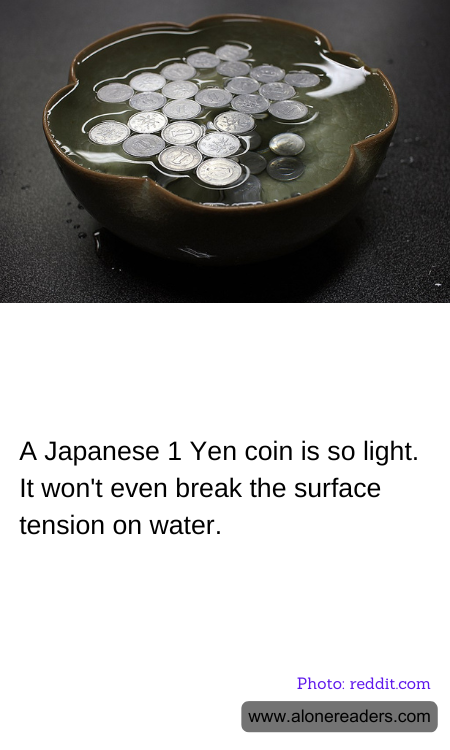
The Japanese 1 yen coin, often admired for its distinctive attributes, epitomizes a unique blend of beauty and physics that surprises many. Made primarily from aluminum, one of the lightest metals used in coinage, the coin weighs just about one gram. This incredibly low weight coupled with a diameter of 20 millimeters and a thickness of only 1.5 millimeters allows it to have an attribute that few other coins can claim: it can float on water.
This floating ability is attributed to the phenomenon of surface tension—a condition on the surface of the liquid that makes it behave like an elastic sheet. Surface tension is the result of the cohesive forces between liquid molecules, which are significantly stronger at the interface between the liquid and air than they are in the liquid itself. The molecules at the surface of the water do not have other like molecules all around them and consequently cohere more strongly to those directly associated with them on the surface.
For most objects, breaking through this tightly bonded layer requires a certain amount of weight or pressure. However, the Japanese 1 yen coin, due to its lightweight and relatively large surface area in proportion to its weight, doesn't exert enough force to break through this molecular film. When carefully placed on the surface of the water, the coin is supported by the water's surface tension, much like a leaf floating on a pond.
This intriguing characteristic not only makes the 1 yen coin a subject of curiosity but also a favorite in educational demonstrations to explain the principles of surface tension and buoyancy. The coin's ability to float can serve as an engaging, real-world application of these scientific concepts, bridging the gap between theoretical physics and tangible experiences.
Moreover, the design and material of the 1 yen coin are emblematic of Japan's minimalist yet functional aesthetic, encapsulated in the intricacy of its minting. On one side, it features a young tree, symbolizing healthy growth, development, and environmental consciousness, themes that resonate deeply with Japanese cultural values.
Thus, the Japanese 1 yen coin, beyond its nominal value and everyday usage, serves as a small marvel of modern minting technology and physics. It not only fascinates those who encounter its floating ability but also illustrates how even the smallest elements of our daily lives can be gateways to deeper understanding and appreciation of the natural world.