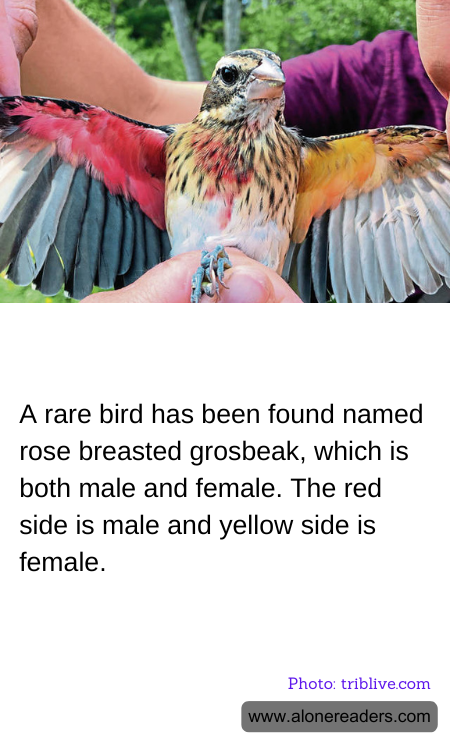
The discovery of a rare bird, the Rose-breasted Grosbeak, exhibiting both male and female characteristics has sparked excitement and curiosity in the ornithological community. This exceptional bird showcases an unusual condition known as bilateral gynandromorphism, where one side of the bird displays male features and the other female characteristics. In the case of this Rose-breasted Grosbeak, the division is stunningly clear: the right side of the bird sports the rose-colored breast patch typical of males, while the left side features the yellow and brown plumage typical of females.
Bilateral gynandromorphism occurs due to a genetic anomaly during the early stages of development, specifically when the egg from which the individual develops contains two different nuclei with distinct sex chromosomes. The result is a creature that is literally half male and half female. This condition, while documented in several species including birds, insects, and crustaceans, remains incredibly rare.
For the Rose-breasted Grosbeak, this unique condition can complicate survival. Mating behaviors, for instance, are influenced by physical appearance and hormone-driven instincts, which can lead to confusion among potential partners. Similarly, the mixed physiological condition could affect the bird’s health and behavior, as the bilateral symmetry extends to physical attributes and possibly internal organ function.
The sighting of such a rare bird provides a unique opportunity for scientists to study gynandromorphism further. Observations can lead to deeper insights into how these animals survive and behave in the wild, as well as how they interact with their peers. Additionally, studying such creatures helps enhance our understanding of genetic anomalies and their effects, potentially offering broader ecological and biological insights.
For birdwatchers and researchers alike, the occurrence of a gynandromorphic Rose-breasted Grosbeak is an intriguing and valuable anomaly, serving as a natural probe into the complex world of genetics and identity in the animal kingdom. The bird not only highlights nature’s unpredictability but also its sheer beauty, reminding us of the fascinating complexity of the natural world.
