More About This Card
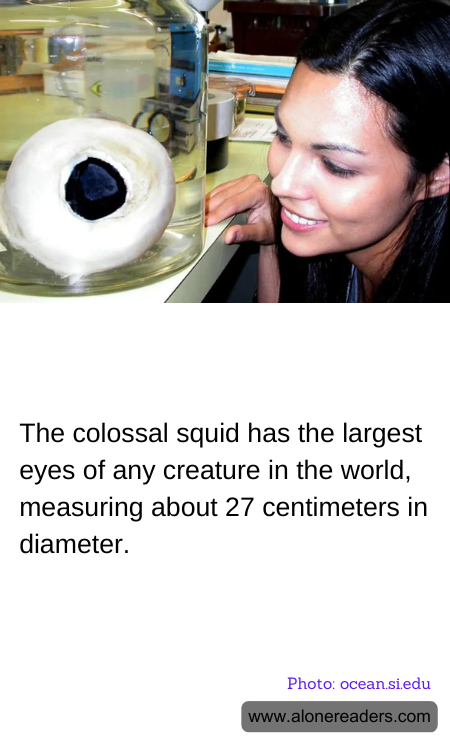
The colossal squid, a mysterious and awe-inspiring creature of the deep sea, holds the record for having the largest eyes in the animal kingdom. Each eye is roughly the size of a soccer ball, measuring about 27 centimeters in diameter, which is essential for survival in the dark depths of the oceans. These massive eyes are not just notable for their size but for their sophisticated design, tailored to the unique, pitch-black environment of the squid's habitat.
Residing mostly in the Southern Ocean, the colossal squid's enormous eyes serve a critical evolutionary advantage. The size of the eyes enhances their ability to capture even the faintest traces of light. Such adaptation is crucial for detecting predators or prey in the virtually lightless waters where they live. The eyes are biologically equipped with a large lens and a wide pupil which allow for maximum light gathering. This is vital for identifying the silhouettes of prey or the approaches of predators from above.
Additionally, the eyes of the colossal squid are believed to help in combating one of its main predators, the sperm whale. The reflective tissue behind the retina of the squid's eyes called the tapetum helps it to detect incoming sperm whales by picking up the faint light reflecting off the whale’s massive body. This unique biological feature adds an extra layer of defense, enabling the squid to take evasive action.
Given the challenging conditions of its environment and the sheer size of its visual tools, the colossal squid is a fascinating subject for marine biologists and researchers. Its elusive nature and extreme living conditions make direct observations and studies difficult, but each encounter provides valuable insights into adaptation and survival strategies at great ocean depths. Moreover, understanding how the colossal squid’s vision works may unlock new understandings in optical science and technologies, potentially leading to advancements in low-light photography and videography, amongst other fields.
Thus, the colossal squid is not just remarkable for its eye size but is a testament to the incredible adaptations of marine life, illustrating the complex interplay of evolutionary biology and environmental demands.