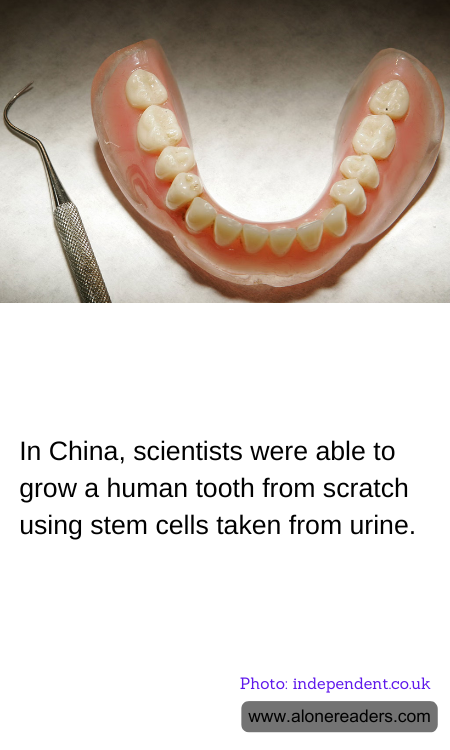
In an astonishing advancement in dental and regenerative medicine, scientists in China have successfully grown a human tooth using stem cells isolated from urine. This groundbreaking experiment not only opens new avenues for dental restoration but also showcases the potential of unconventional sources of stem cells in medical science.
The process involves extracting stem cells from the urine, which are then manipulated in the lab to convert them into induced pluripotent stem cells (iPSCs). These iPSCs are capable of developing into many different types of cells, including those needed to create teeth. By cultivating these cells under specific conditions, researchers can guide their development into structures resembling natural teeth.
This method employs a 'tooth germ' model in which the iPSCs form a precursor to the tooth. This germ is then implanted into the jaws of mice where it develops into a functional tooth. The tooth grown through this method not only has the capability to perform normal functions but also integrates seamlessly with surrounding tissues, including connecting to the blood supply.
What makes this method particularly intriguing is its source – urine, which is typically considered a waste product. Using urine not only provides an easy and non-invasive source of cells but also reduces the ethical concerns associated with using embryonic stem cells. However, there are reservations about the efficiency of using iPSCs from urine, considering potential mutations and lower conversion rates when compared to other sources like blood or skin cells.
Despite these challenges, the experiment highlights a potential shift in regenerative medicine, offering hope for millions who suffer from tooth loss due to disease, decay, or injury. It also underscores a broader possibility of using iPSC technology to regenerate other organs and tissues, pushing the boundaries of medical science. As research progresses, the protocol needs to be refined and made safe for human applications, including ensuring that the cells used do not carry mutations that could lead to unwanted outcomes.
This endeavor not only exemplifies innovative thinking but also emphasizes a sustainable approach by using bio-waste products. As science advances, such experiments will pave the way for more sustainable, ethical, and accessible healthcare solutions, harmonizing medical advancements with ecological and ethical considerations.
