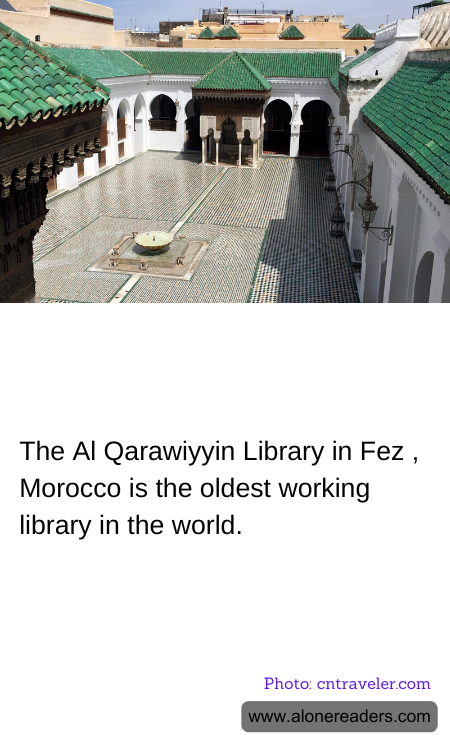
Nestled in the heart of Fez, Morocco, the Al Qarawiyyin Library stands as a testament to the rich history of learning and culture in the Islamic world. Founded in 859 AD by Fatima al-Fihri, a woman notable for her dedication to education and religion, the library is part of one of the oldest universities in the world, the University of al-Qarawiyyin. Despite being centuries old, this library continues to function, keeping alive the luminous legacy of Islamic scholarship.
The significance of the Al Qarawiyyin Library extends beyond its age. It has been a center of knowledge and learning that attracted scholars from around the Islamic world and Europe. The library houses collections that include rare and valuable manuscripts, some of which are unique to its archives. These manuscripts cover a diverse range of subjects such as theology, law, medicine, and astronomy. Among its treasures are a ninth-century Qur'an, the earliest collection of hadith by Ibn Khaldun, and the original manuscript of Ibn Khaldun’s "Muqaddimah". The preservation of these manuscripts has provided invaluable insights into the intellectual history of the Muslim world and the interactions between different cultures and civilizations.
Over the centuries, the library has experienced periods of decline and revival, reflecting the tumultuous history of the region. In recent years, a major restoration project was undertaken by the Moroccan Ministry of Culture and the University of al-Qarawiyyin. The restoration, led by architect Aziza Chaouni, aimed to rehabilitate the library's structure while preserving its historic character. Modern amenities were added, including climate control systems to protect the manuscripts, a new reading room, and facilities for digital cataloging. This careful blend of preservation and innovation ensures that the library continues to serve scholars and students while adapting to the needs of the 21st century.
Today, the Al Qarawiyyin Library is not only a repository of books and manuscripts but also a symbol of the enduring legacy of learning in Morocco and the Islamic world. It stands as a bridge that connects the past to the present, offering researchers and the public alike, a rare glimpse into the scholarly pursuits of early Islamic civilization. With its doors now open to the public, visitors are offered the unique opportunity to explore its ancient halls, to stand amidst history, and to witness the continuing journey of one of the oldest working libraries in the world. As such, the Al Qarawiyyin Library remains a beacon of knowledge, preserving the past and inspiring future generations.
