More About This Card
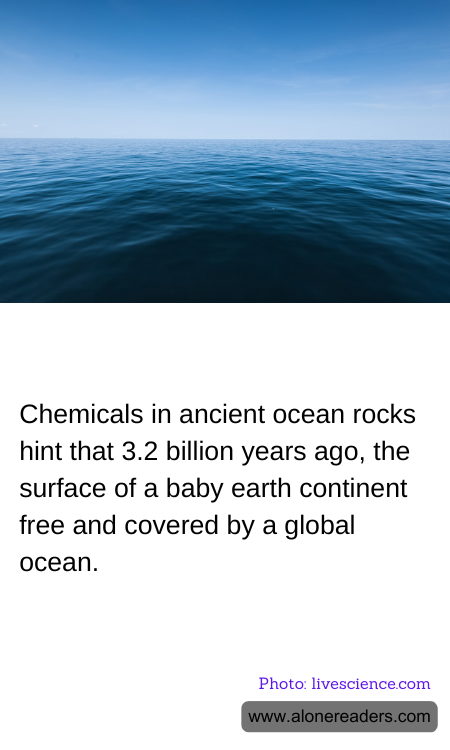
Around 3.2 billion years ago, Earth was vastly different from the planet we inhabit today. Recent studies by geologists and chemists analyzing ancient ocean rocks have provided compelling evidence that during Earth's early years, the planet's surface was predominantly covered by a boundless global ocean, and the concept of continents as we understand them today was still in its nascent stage. This hypothesis is reinforced by the discovery and analysis of chemical signatures within these primordial rocks, which suggest a minimal exposure of continental land above sea level.
The analysis of such rocks reveals a fascinating story about Earth’s formative years. Researchers detected specific isotopic ratios typical of interactions occurring between seawater and the oceanic crust, which pointed to an overwhelmingly aqueous environment. Elements like iron and sulfur underwent chemical changes that are indicative of reactions happening under shallow waters, largely influenced by the vast global ocean. Moreover, these rocks showed low levels of certain isotopes that would have been more abundant had there been more extensive land areas exposed to atmospheric erosion or riverine transport.
This finding is crucial because it shifts previous understandings of early Earth’s geography and climate. The dominance of oceanic cover suggests that any continental crust was either transient, submerged, or minimal during this period. Such conditions would have significant implications for the early climate, as large bodies of water could have stabilized the planet’s temperature and possibly influenced the development of life. It aligns with theories that posit life began in hydrothermal vent systems deep in the oceans before migrating to more diverse ecological niches.
Furthermore, the notion of a baby continent, peeking partially from the ocean, opens exciting avenues for understanding continental formation and growth. The dynamics of Earth's crust at that time, under constant reshaping by volcanic and tectonic activity, might explain how continents eventually evolved from these minimal exposures. As tectonic plates moved and interacted, they could have gradually fused these early proto-continents into the larger landmasses recognizable today.
This gradual shift from a primarily oceanic planet to one with significant continental presence likely played a pivotal role in the development of conditions suitable for more complex life forms. The alteration in landscape from vast blue depths to diverse terrestrial and marine environments would create new niches, driving evolutionary processes that led to the rich biodiversity we see on Earth today.
These insights into Earth's early state not only deepen our understanding of our own planet’s history but also assist in the study of other celestial bodies. By understanding the processes that shaped our planet, scientists can better hypothesize about the conditions on similar planets in the universe, potentially guiding the search for life beyond Earth.