More About This Card
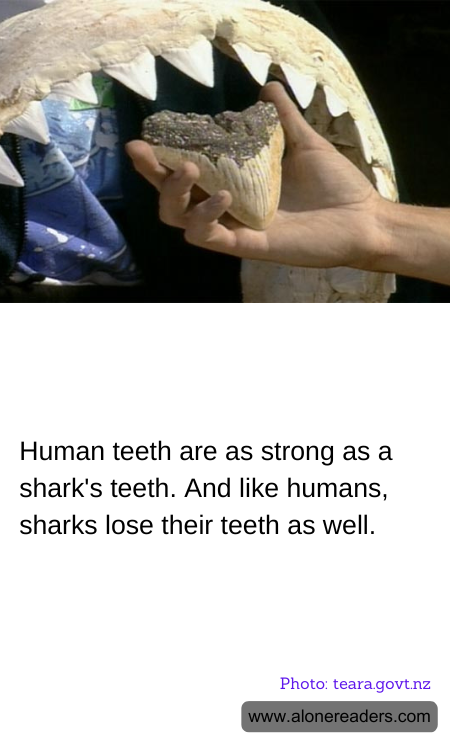
Human teeth and shark teeth, while vastly different in appearance and structure, share remarkable similarities and fascinating differences. Both human and shark teeth are composed primarily of dentin, a hard calcified tissue, which is then topped by enamel, the hardest substance in the animal body. This composition gives both types of teeth exceptional strength for biting and chewing.
Shark teeth are often perceived as being much stronger than human teeth because sharks are notorious for their ability to bite through hard substances, including shellfish and fish bones. Sharks' teeth are generally triangular, razor-sharp, and serrated, factors that enable them to tear through flesh with high efficiency. This design makes them highly effective for their diet and the aquatic environment in which they hunt.
In comparison, human teeth are designed more for a varied diet, consisting of vegetables, fruits, meats, and grains. Our teeth are less sharp but are similarly strong in terms of withstanding bites and chewing forces. Human teeth include incisors, canines, premolars, and molars, each shaped differently to handle different types of food. However, under immense pressure, human teeth can chip or fracture because they are not meant for the level of aggressive biting seen in sharks.
Interestingly, both humans and sharks continuously lose and replace their teeth, though in significantly different ways. Humans typically have two sets of teeth throughout their life—baby teeth, which are eventually replaced by permanent adult teeth. Once the full set of adult teeth is in place, no natural replacement occurs, and tooth loss can only be remedied with artificial replacements.
Sharks, on the other hand, have the unique ability to continuously grow and replace teeth throughout their lives. They possess multiple rows of teeth, which rotate forward like a conveyor belt; as one tooth falls out, another one moves forward to take its place. This ability ensures sharks always have a functional set of teeth, which is crucial for their survival.
Thus, while human teeth and shark teeth share a basic structural strength, their functions, shapes, and life cycles reflect the differing needs and evolutionary paths of the species. Their fascinating differences and adaptations highlight the versatility and complexity of nature in responding to environmental and dietary demands.