More About This Card
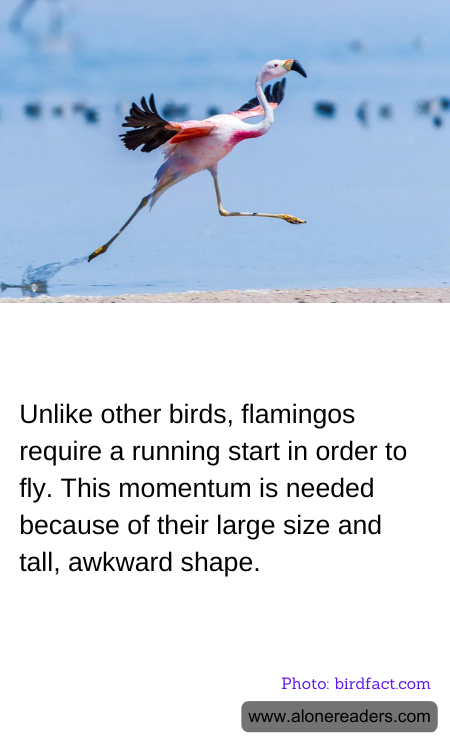
Flamingos, with their striking pink feathers and distinctive long legs and necks, are one of the most recognizable birds on the planet. However, their elegant appearance belies the awkwardness they exhibit when initiating flight. Unlike many other bird species that can simply spring into the air from a stationary position, flamingos require a runway-like approach to take off. This unique behavior is primarily due to their physical characteristics.
Flamingos are relatively large birds, and their long legs and necks contribute to a body structure that is quite different from more compact flying birds like sparrows or robins. Because of this tall and lanky build, flamingos cannot easily achieve the rapid wing beats needed to generate immediate lift. Instead, they need to gather momentum with a running start, using both their long legs and broad wings to gradually pick up speed.
Once they have attained enough ground speed, flamingos use their powerful wings to lift off. Their wing span, which can reach up to 150 cm, is another attribute that supports their flight needs. During the run, these wings are flapped vigorously, helping to propel the bird upward, while their webbed feet push against the ground. This activity usually takes place in a group, as flamingos are social birds and often fly in large flocks.
The need for a runway is also a factor in their choice of habitat. Flamingos prefer large, open areas such as salt flats, lagoons, and shallow coastal regions where they have enough space to make their running starts without obstruction. This requirement influences their migration patterns and affects where they are able to live and breed.
Despite the clumsiness of their takeoff, once airborne, flamingos are quite adept at flying. They are capable of traveling long distances at high altitudes, navigating between their feeding and breeding sites. During flight, flamingos are a spectacular sight, with their legs and neck outstretched, moving in a coordinated, rhythmic manner that contrasts sharply with their ungainly launching technique.
Understanding these unique aspects of flamingo behavior highlights the adaptability and resilience of these birds, offering a deeper appreciation for their intriguing life strategies.