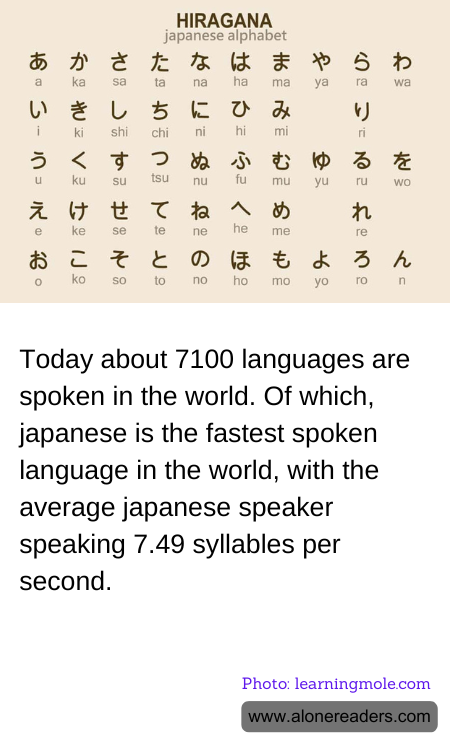
Languages form the backbone of our diverse global society, enabling us to communicate, share ideas, and understand each other's cultures. Among the approximately 7100 languages spoken worldwide, each varies not only in terms of vocabulary and grammar but also in the pace at which it is spoken. Notably, Japanese stands out as the fastest spoken language globally.
Japanese, the primary language of Japan, is spoken by around 128 million people. It is characterized by a complex system of honorifics reflecting the nature of Japanese society, with its emphasis on hierarchy and respect. Linguists point out that the average Japanese speaker articulates about 7.49 syllables per second. This rapid pace can be attributed to the language’s syllable structure, which mainly consists of simple, open syllables that follow a consonant-vowel pattern. This structure facilitates quick and fluid speech.
The speed of spoken language can have significant implications for communication, learning, and even translation. Faster speech can lead to higher information density per units of time, but it can also create challenges in understanding and retention for non-native speakers. Additionally, in an increasingly globalized world, interpreters and translators must accommodate these variations in speech rate to ensure accurate and effective communication.
Understanding the dynamics of spoken languages like Japanese not only adds to our linguistic knowledge but also enhances mutual respect among different cultures. It serves as a reminder of the remarkable complexity and diversity of the ways in which we communicate as a global community.
