More About This Card
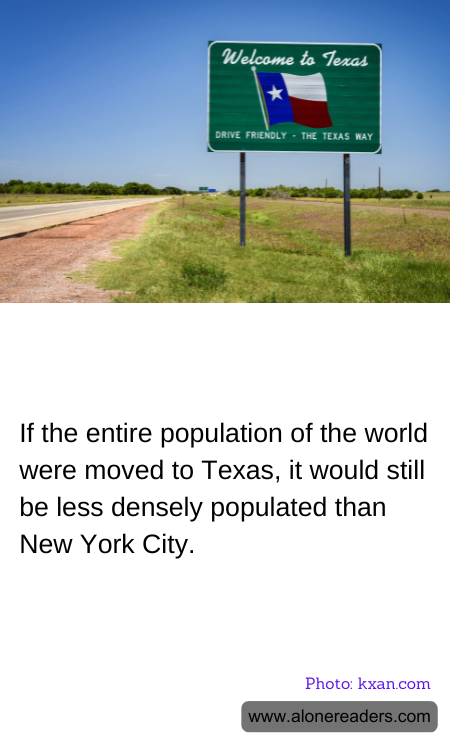
The idea of moving the entire world's population to one geographical area, such as the state of Texas, presents a fascinating exercise in spatial imagination and demographics. If we consider the enormity of Earth's population, which exceeds 7 billion people, and confine it within the borders of Texas, the resulting density is an intriguing topic to explore.
Texas, known for its vast landscapes and significant size, covers an area of about 268,596 square miles. When compared to New York City, which sprawls over a mere 302 square miles, Texas seems capable of accommodating a large number of inhabitants. If we were to distribute the entire global population within Texas, the density calculation reveals a surprising possibility.
Distributing over 7 billion people across the expansive area of Texas results in a population density of approximately 26,403 people per square mile. This figure might sound extraordinarily high at first glance. However, when contrasted with the population density of New York City, which stands at over 27,500 people per square mile, a nuance comes into play. Despite the vast influx of people in this hypothetical scenario, Texas would still be less densely populated than New York City.
This thought experiment underscores the remarkable concentration of people in urban areas like New York City, which, despite its small area, manages to support an exceedingly high population density. Meanwhile, it paints a picture of just how large and accommodating Texas is. Though moving the global population to Texas is impractical for countless logistical, ecological, and social reasons, the comparison provides a stark perspective on urban population density versus the more spread-out populations in larger states or regions.
Considering the vast difference in living conditions that would result from such an unprecedented concentration of people in one state, the dynamics of urban planning, resource management, and infrastructure development would face unimaginable stress. Yet, this scenario allows us to appreciate the immense challenges and intricacies involved in managing highly concentrated urban populations existing today. As cities like New York continue to grow and evolve, understanding these dynamics becomes crucial for sustainable urban development worldwide.