More About This Card
Grapes are a popular snack worldwide due to their sweet taste and nutritional benefits. However, when subjected to microwave heating, an ordinary grape can exhibit unusual behavior, such as exploding. This peculiar phenomenon occurs due to the unique way microwaves interact with the grapes.
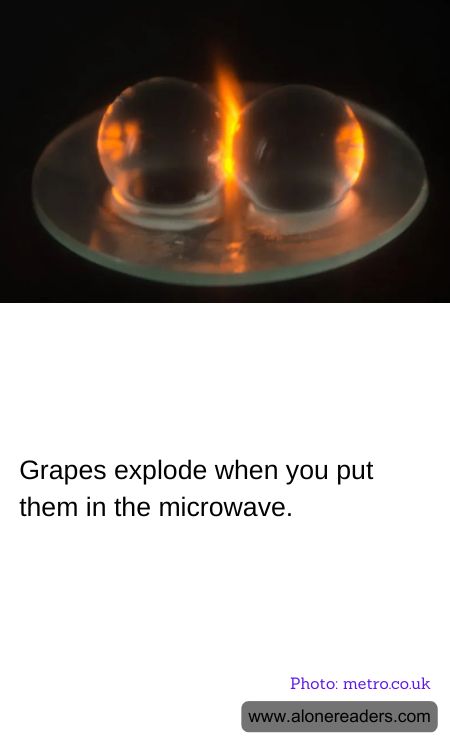
Microwaves heat food by generating waves that excite water molecules, causing these molecules to vibrate and produce heat from within. Grapes, which contain a significant amount of water, absorb microwave energy. When a grape is cut in half and the halves are placed close together in the microwave, the area where the cut faces nearly touch serves as a hot spot for microwave energy. This is because the microwaves pass through the high-water content of the grape, intensifying the energy in the tiny gap between the halves.
As microwaves heat the water inside the grapes, pressure builds up. Grapes have a relatively tight skin around them, which can act as a barrier, trapping steam inside. If the steam under pressure has no way to escape, it finds the weakest spot in the skin and breaks through, often explosively. The high sugar content in grapes also contributes to this effect, as it can turn into a superheated syrup that further drives the explosion when rapidly heated.
This explosive behavior sparked curiosity among scientists and led to a series of experiments and studies. Researchers at the University of Sydney and Trent University in Canada observed and concluded that the microwave effect in halved grapes and similarly shaped small objects with high water content can generate a plasma. When grapes are cooked in the microwave, ions and electrons break free from the grapes’ atoms and molecules, interacting with the microwaves and creating a glowing plasma of charged particles.
For safety reasons, it is discouraged to experiment with microwaving grapes at home, as it poses a risk of damaging the microwave or causing injury. The phenomenon serves as a practical reminder of the complexity of electromagnetic interactions in everyday materials and adds a layer of caution to the use of household appliances. Moreover, it underscores the importance of understanding the physical properties and behaviors of different foods in various culinary situations, highlighting the surprising impact of applying science to our everyday lives.