More About This Card
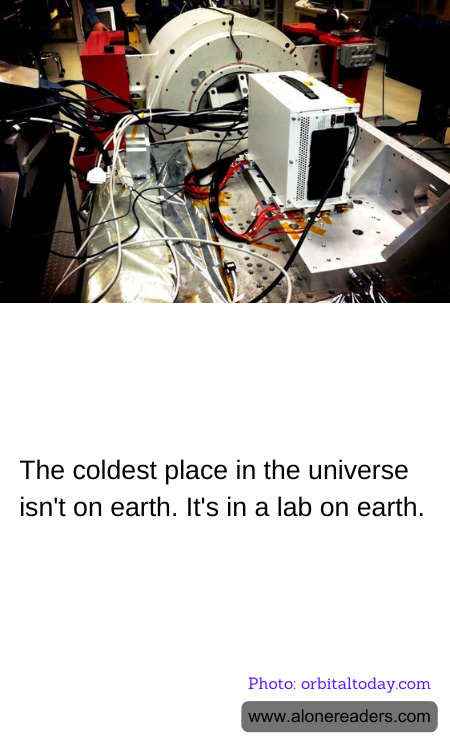
The title of the coldest place in the universe might evoke images of interstellar clouds or remote, frost-bitten planets. However, it might come as a surprise to learn that this record-setting location is right here on Earth, inside a laboratory. Researchers have managed to create temperatures in labs that are colder than anywhere naturally occurring in outer space. These feats of cooling are not just for setting records; they are critical for advancing our understanding of physics, particularly quantum mechanics.
Super-low temperatures, often mere fractions above absolute zero—the theoretical lowest possible temperature (-273.15 degrees Celsius or -459.67 degrees Fahrenheit), where atoms should theoretically stop moving—are achieved in laboratory settings by using sophisticated techniques like laser cooling and magnetic evaporative cooling. For instance, at the Massachusetts Institute of Technology (MIT), scientists have cooled a sodium gas to less than half-a-billionth of a degree above absolute zero. In such a hyper-cooled environment, classical physics gives way, and the quirky, counterintuitive rules of quantum mechanics begin to dominate.
The behavior of atoms at these extreme lows is paradoxically wild: they form new states of matter, like Bose-Einstein condensates, where separate atoms begin to overlap, behaving more like waves than particles. This condensate was predicted by Albert Einstein and Satyendra Nath Bose in the 1920s but wasn't created in the laboratory until 70 years later. Understanding these states allows physicists to probe the fundamental properties of matter and potentially harness quantum mechanics for new technologies including supercomputing and highly precise sensors.
The implications of such research stretch beyond pure science. In the technological realm, ultra-cold atoms are paving the way for the next generation of precision measurement and navigation systems that could outperform today's GPS. Furthermore, they are critical to the development of quantum computers, which promise to revolutionize fields ranging from cryptography to pharmaceuticals through their immense processing power and ability to solve problems that are currently intractable for classical computers.
Thus, the coldest place in the universe within these laboratories is not just a wonder of modern science but also a fertile ground for the technological advancements that might shape the future of humanity.