More About This Card
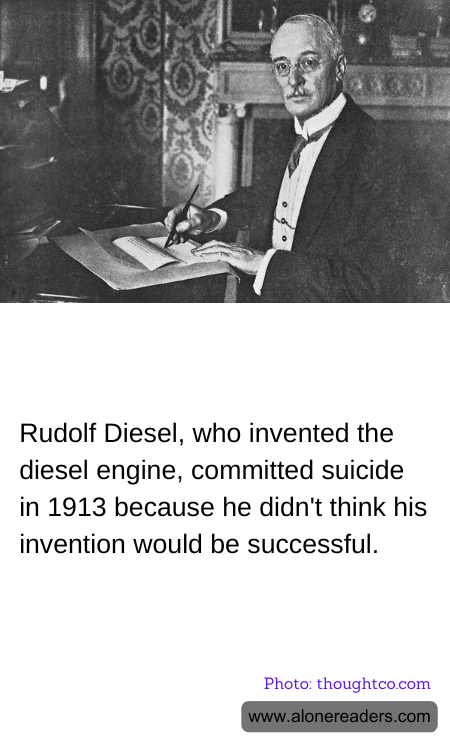
The story of Rudolf Diesel, the inventor of the diesel engine, is both fascinating and tragic. Diesel developed his eponymous engine in the late 19th century, with the first successful model running in 1897. Unlike gasoline engines that use spark ignition, Diesel's engine used compression ignition, which proved to be more efficient. Despite the initial success and revolutionary impact of his invention, Diesel faced numerous challenges, including financial difficulties and patent disputes.
The circumstances surrounding Rudolf Diesel's death are shrouded in mystery. On the night of September 29, 1913, Diesel boarded the SS Dresden, a steamship traveling from Antwerp, Belgium, to Harwich, England. He was seen on the ship that evening, but by the morning of September 30, he had disappeared. His room was found empty, his bed had not been slept in, and personal belongings, including his hat and overcoat, were neatly arranged on the deck. Ten days later, a Dutch boat found a body in the North Sea; personal items retrieved with the body, such as a pill case, were identified by Diesel's son as belonging to his father.
The cause of Diesel's death has led to much speculation. While many historians believe he died by suicide, others conjecture that he might have been murdered or that his death was an accident. Descriptions of Diesel's state of mind before his disappearance suggest he was under a great deal of stress, both personally and professionally. Financial pressures, health issues, and the fear that his invention might not become successful are all factors that could have contributed to his presumed decision to end his life.
Despite the mysterious and unfortunate circumstances of his death, Diesel's legacy lives on through his invention. Today, diesel engines are crucial in powering vehicles and machinery worldwide, particularly in industries where heavy loads and long operating hours are common. His innovation not only transformed the automotive industry but also had a significant impact on other sectors, such as shipping and agriculture.
Thus, while Diesel's life ended in ambiguity and despair, his contribution to engineering and the subsequent impact on global economies is undeniable. His engine has been foundational in the evolution of transportation and industry, cementing his place as one of the notable inventors in history.