More About This Card
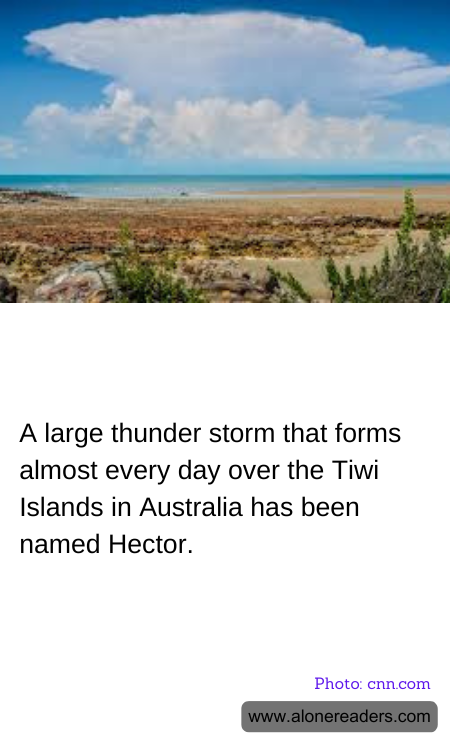
In the tropical region near the Tiwi Islands of Australia, an extraordinary meteorological phenomenon occurs with remarkable regularity. Named "Hector the Convector", this large thunderstorm is a powerful and consistent force in the region, forming almost daily during the wet season, which stretches from approximately November to April. These islands, located to the north of Darwin in the Timor Sea, provide a unique geographical setting that contributes to the recurring development of Hector.
Hector is not just any storm; it's known for its impressive size and intensity. The storm typically develops in the early afternoon as the sun heats the earth's surface, causing moist air to rise and form cumulonimbus clouds. These clouds can tower up to heights of 20 kilometers and are often visible from great distances, even from the mainland of Northern Australia. The mechanics of Hector are tied closely to the sea breezes that converge over the Tiwi Islands, fueled by the differential heating of the land and surrounding waters.
The phenomenon has become a case study for meteorologists who are fascinated by its predictability and power. It offers a rare opportunity to study storm dynamics and cloud physics in a natural laboratory. The consistency of Hector allows scientists to track changes and gather data on tropical storms with a precision that is not possible in less regular conditions. For weather enthusiasts and researchers, Hector provides a nearly daily spectacle of nature's forces at play.
Moreover, the storm has cultural and practical impacts. Locally, it's well-known among the islanders and Darwin residents, where it is often a topic of conversation and even affects planning and daily activities. Due to its intensity and frequency, Hector also influences local climate conditions, such as rainfall patterns and temperature, playing a crucial role in the ecology of the region.
Tourists visiting the area are often treated to the dramatic display of towering clouds and lightning that Hector brings. Photographers and storm chasers alike are drawn to the islands to capture the raw beauty of this meteorological giant. Thus, Hector not only shapes the environment and scientific understanding but also ignites the imaginations and interests of those who witness its grandeur.