More About This Card
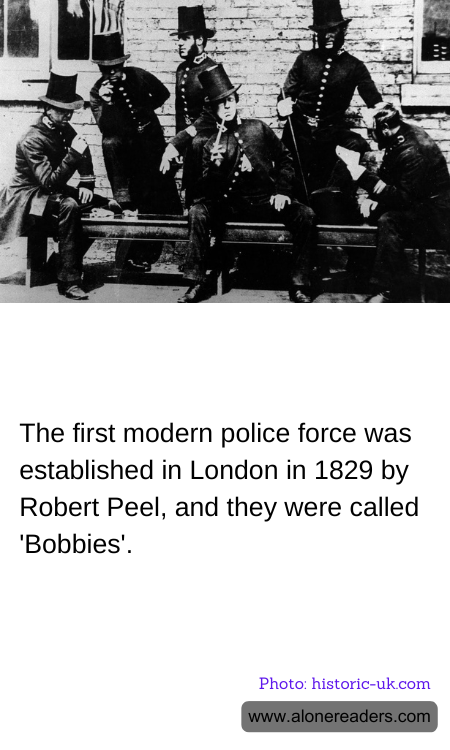
The establishment of the first modern police force in 1829 by Robert Peel marked a significant transformation in law enforcement. Known colloquially as "Bobbies," this new force was officially titled the Metropolitan Police Service. It was founded in London, reflecting an innovative approach to the increasing rate of crime and disorder of the time. Before this formalization, law enforcement in cities was often chaotic, comprising a disorganized mix of night watchmen and private individuals.
Robert Peel, then Home Secretary in the British Cabinet, introduced the Metropolitan Police Act of 1829 to Parliament, laying the foundations for the service. This legislation pioneered many of the concepts of modern policing today, including the belief that the goal of law enforcement should be prevention. Peel emphasized the importance of a police force that would be organized, disciplined, and centrally controlled. He defined the philosophy of policing with his nine principles, one of which famously stated, "The police are the public and the public are the police." This principle encapsulated his vision that the legitimacy of the police derived from the public's consent and cooperation rather than mere fear of authority.
The members of the new police force were outfitted in blue uniforms to distinguish them from the military, who wore red and white, and to signify their civic rather than martial role. They were initially tasked mainly with patrolling the streets to deter crime, focusing on visibility as a means of maintaining public order. Their presence aimed to deter potential offenders through their proactive rather than reactive approach to law enforcement.
The name "Bobbies" itself is derived from the first name of their founder, Robert Peel. This nickname endearingly rooted the force in public consciousness, and it is still in use today to refer to British police officers. This legacy also extends globally, as the foundational principles laid down by Peel influenced the development of police forces in other countries, establishing blueprints for structuring civil law enforcement based on centralized command and community integration.
In reflection, the creation of the Metropolitan Police Service under Robert Peel’s guidance provided not only a practical solution to crime but also introduced a new ethos in law enforcement that respected civil principles and called for the police to maintain public trust through ethical conduct. The inception of the "Bobbies" was a crucial turning point, establishing precedents for the professionalization of police forces worldwide and forever altering the landscape of public safety.