More About This Card
Bald eagles, America’s national bird, are as proficient in the art of flying as they are symbolic of freedom. A fascinating aspect of their biology is their method of maintaining balance during flight, particularly how they manage their feathers. Like all birds, bald eagles periodically lose feathers, a process known as molting. However, what sets these majestic birds apart is their ability to maintain perfect symmetry even during this process.
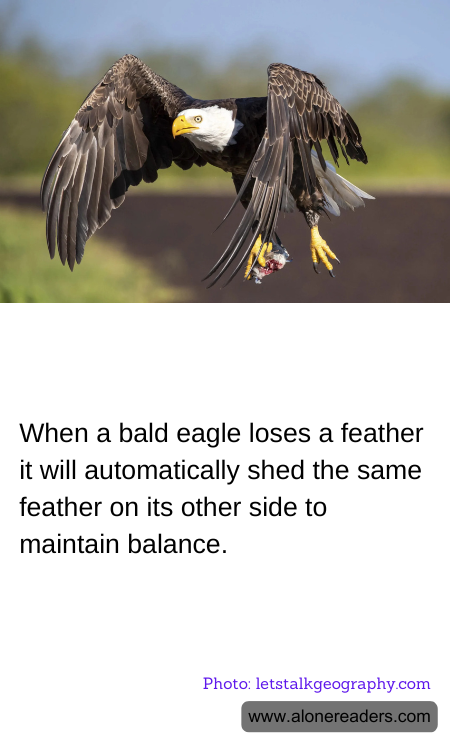
When a bald eagle loses a feather, especially one of the larger flight feathers, it automatically sheds a corresponding feather on the opposite side. This unique adaptation is crucial for keeping the bird balanced during flight. Feathers play a vital role in flight mechanics, influencing everything from steering and braking to lift and thrust. Losing a feather on one wing without losing the corresponding feather on the other could disrupt the bird's aerodynamics, potentially making flying inefficient or even hazardous.
This natural balancing act is a beautiful example of the intricacies of evolution and adaptation in birds. Molting is typically a gradual process, ensuring that the bird remains flight-capable and that no side is more heavily molted than the other at any time. For bald eagles, this could mean the difference between successful hunting and starvation, particularly during harsher seasons when food is scarce and efficient hunting is crucial.
Moreover, the process of symmetric feather loss is not just about physical balance; it also helps maintain the insulation and waterproofing qualities of the eagle’s plumage. Each feather on an eagle’s wing and tail corresponds to another in a design that optimizes air resistance and control. Thus, the loss of a single feather triggers the loss of its opposite to retain the bird’s sleek form and flight efficiency.
In essence, this process showcases a remarkable survival strategy, fine-tuned by nature over millennia. For bird watchers and ornithologists, this aspect of bald eagle behavior underscores the complexity and elegance of these avian predators. It ties into broader themes of biological symmetry and organism adaptation, reflecting a harmony between form and function that is evident throughout the natural world.