More About This Card
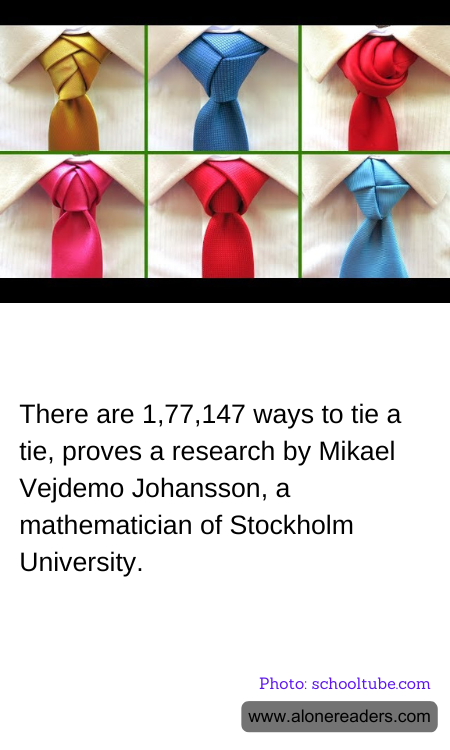
Ties have long been a staple in men's fashion, serving as a symbol of professionalism and elegance. Traditionally, most people are familiar with a few ways to tie a tie, such as the Windsor, Four-in-Hand, or the Bow Tie. However, recent research by Mikael Vejdemo-Johansson, a mathematician at Stockholm University, reveals that the possibilities extend far beyond these common methods. According to his study, there are exactly 177,147 ways to tie a tie, opening up a realm of creativity and personal expression in what might seem like a simple accessory.
Vejdemo-Johansson's research into the complexity of tie knots uses mathematical modeling to delve into the numerous configurations possible with a standard necktie. By employing the mathematical theory of knots and combining it with practical constraints, such as the length and width of the tie and the final appearance, his study provides a systematic exploration into the art of tie-tying. His findings imply that rather than being restricted to conventional styles, individuals can experiment with a vast array of patterns to suit their personal taste and the occasion.
This extensive variety in tie-tying methods allows for personalization and differentiation in a world where fashion often tends towards uniformity. For instance, someone looking to make a bold statement might opt for a complex and intricate knot, while another might choose a simple, understated style for a more conservative event. Additionally, this newfound understanding of the complexity of tie knots can be a boon for fashion designers and stylists aiming to bring a fresh take on men's accessories.
Moreover, exploring these numerous options can add an element of fun and challenge to dressing up. Learning different tie knots could become a hobby, much like learning cooking recipes or practicing musical instruments. It also presents an opportunity for social bonding, as individuals teach each other new knots and share tips on perfecting their technique.
In summary, Vejdemo-Johansson's research not only expands our understanding of a common element of daily attire but also enhances the cultural richness of fashion. By combining the elegance of mathematical theory with the artistry of style, the study encourages a deeper appreciation for both the scientific and expressive aspects of tying a tie. Whether for formal occasions, professional settings, or personal style, the vast array of tying options turns the humble tie into a canvas of personal expression.