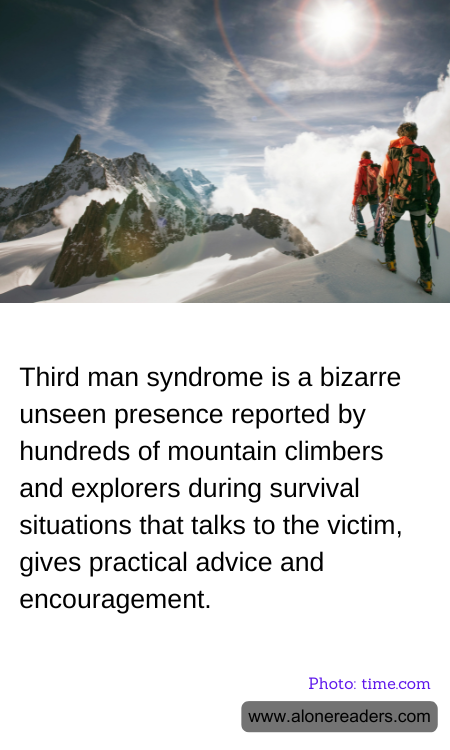
The phenomenon known as the "Third Man Syndrome" taps into the eerie and engrossing realm of extreme human experiences. This curious sensation often occurs during extreme survival situations, wherein individuals perceive or encounter an invisible presence that assists or comforts them. This phenomenon is not limited to but is particularly noted among mountain climbers, polar explorers, and sailors, who find themselves in solitary, dangerous situations.
This presence, often referred to as the "Third Man," appears to provide company, guidance, or even life-saving advice during critical moments. The name of the phenomenon itself was popularized by the famous British explorer Ernest Shackleton in his book recounting the harrowing Imperial Trans-Antarctic Expedition. During a particularly perilous segment of his journey in 1916, Shackleton reported the sense of an unseen companion walking alongside him and his two real-life companions, offering encouragement and ensuring they were not alone in their struggle for survival.
Scientists and psychologists have delved into several explanations for this phenomenon. One prevalent theory suggests that extreme physical and mental exhaustion, combined with isolation and imminent danger, triggers a protective mechanism in the brain. This mechanism somehow externalizes the inner self as a separate entity – basically a hallucination – to give the sufferer a psychological boost for survival. Cognitive processes and imagination meld in ways that provide the struggler with the capacity to endure their ordeal, fostering a mental state in which they can better handle their dire circumstances.
From a neurological perspective, it's believed that the syndrome could be linked to the temporal-parietal junction of the brain, an area responsible for distinguishing between the self and others. Under extreme stress or sensory deprivation, this region can malfunctions, leading the survivor to project their internal thoughts and dialogues as if they originated from an external source – the so-called "third man."
Interestingly, this phenomenon has been reported to have a universally positive presence. Unlike other forms of hallucination experienced under distress which are often menacing or neutral, the Third Man typically appears supportive and benevolent, focusing on the survival and well-being of the individual.
In exploring the depths of human perception and psychological endurance, "Third Man Syndrome" not only opens up questions about human consciousness and its mysteries but also highlights our innate drive to survive against all odds. Whether deemed a quirk of human psychology or a more profound spiritual experience, this syndrome underscores the resilience of the human spirit in the face of extreme adversity.
