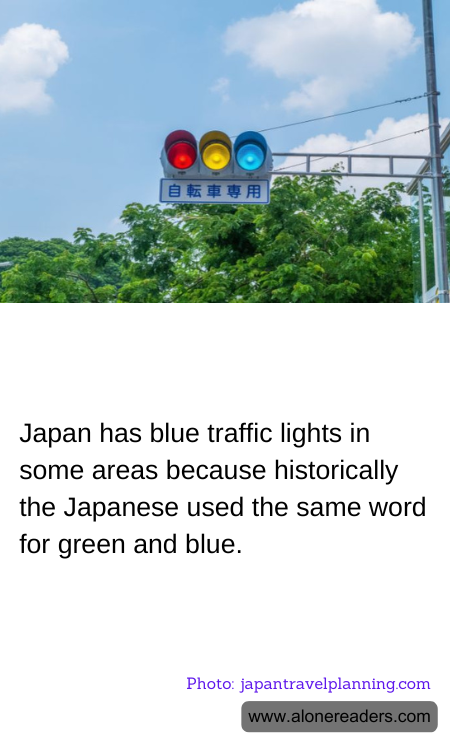
In Japan, an intriguing aspect of daily life includes the hue of the traffic lights. Surprisingly, what is internationally recognized as green lights are perceived as blue in Japan. This peculiar phenomenon roots back to the Japanese language and cultural perception of color. Historically, Japanese did not distinguish between green and blue; both were referred to by the same term: "ao." This term covered a spectrum of what English speakers would identify as blue and green shades.
The modern traffic light, modeled after those standardized in the West, implemented the green light to signal 'go,' facilitating a uniform system for drivers worldwide. However, due to the linguistic and cultural perspective in Japan, this 'green' light was perceived as "ao," thus registering as blue in the public consciousness and language.
Legal adaptations have been made to recognize this unique cultural perspective. Officially, the government mandates the use of what is legally defined as the bluest shade of green permissible—it’s a green with a hint of blue, standing at the boundary just before it turns fully blue. This adjustment adheres to international standards while respecting traditional Japanese linguistic usage.
This distinct color coding is a fascinating example of how historical and cultural nuances influence modern living and laws, ensuring that tradition coexists with global uniformity. It exemplifies Japan's ability to adapt to international standards while keeping its cultural identity intact, bridging past perceptions with the present reality in a way that respects both historical context and modern necessity.
