More About This Card
The human brain is an extraordinarily adaptable organ, constantly surprising scientists with its ability to accommodate new challenges. Recent studies have suggested that it can even handle the cognitive demands of controlling an additional limb—such as a third thumb. This revelation could have groundbreaking implications for prosthetics and human augmentation technology.
Research into this fascinating possibility reveals that the brain’s neuroplastic capabilities are the key to integrating a new body part. Neuroplasticity refers to the brain's ability to reorganize itself by forming new neural connections throughout life. This ability means that the brain can not only recover from injury but can also adapt to new physical conditions or enhancements.
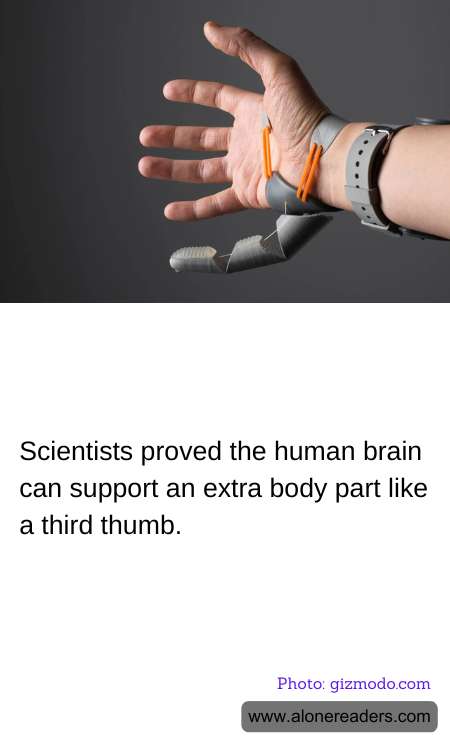
Experiments conducted involved participants using a specially designed robotic thumb, which was controlled via pressure sensors attached to their feet. Over time, users were able to perform complex tasks with the thumb, such as building structures with blocks, more efficiently. Brain imaging studies before and after the experiment showed that areas of the brain responsible for hand and finger movement had adapted to control the new thumb.
This suggests that the brain had not only learned to use the robotic thumb but had also integrated it into the user’s self-image and motor control systems. The ease with which participants adapted to the extra thumb was a consistent outcome, highlighting the brain's remarkable ability to incorporate new tools or limbs.
These findings have profound implications, particularly in the field of prosthetics. For individuals who rely on artificial limbs, the ability of the brain to adapt and control these extensions as parts of their own body can significantly enhance their functionality and quality of life. Future prosthetic designs might incorporate additional limbs to assist with more complex tasks, fundamentally enhancing human capabilities.
Additionally, this research could lead to new developments in wearable robotic systems, sometimes referred to as exosuits, designed to augment human performance in various fields, from rehabilitation to the military.
With the discovery that the human brain can support an extra body part like a third thumb, we stand on the brink of a new era in human capability enhancement. The continued exploration of this phenomenon will not only advance our understanding of the human brain but also push the boundaries of what is possible in medicine, technology, and beyond.