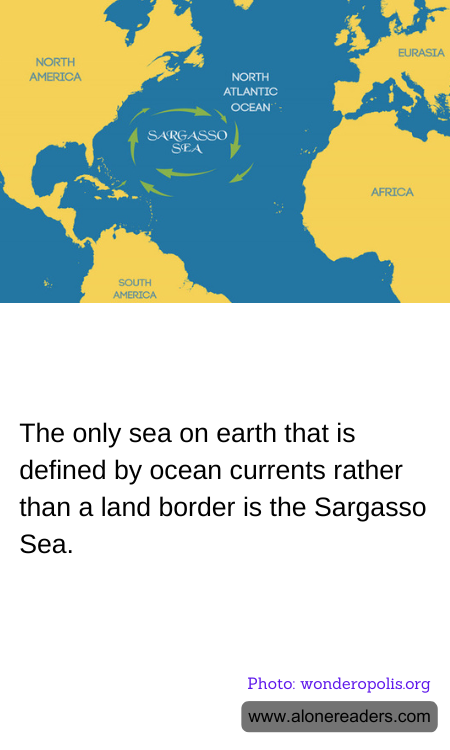
The Sargasso Sea, a unique and intriguing body of water, stands out among the world’s seas due to its rare distinction of being defined not by land boundaries, but by ocean currents. Situated within the North Atlantic Ocean, it is surrounded by four major currents forming its borders: the Gulf Stream to the west, the North Atlantic Current to the north, the Canary Current to the east, and the North Atlantic Equatorial Current to the south. These currents create a distinct ecological region characterized by deep blue water, relatively still seas, and minimal land influence.
Named after the Sargassum seaweed that prolifically floats on its surface, the Sargasso Sea plays a vital ecological role. This floating seaweed provides a critical habitat for a diverse range of marine species. Creatures such as eels, shrimp, crab, and tiny fish find shelter in these floating rafts, which offer both food and protection from predators. The sea is also the only breeding ground for the European and American eels. These eels travel thousands of miles to spawn in its waters, a fascinating journey that remains a subject of extensive scientific study.
However, the Sargasso Sea faces environmental threats. The same currents that define its boundaries also bring in a vast amount of marine debris, particularly plastics. Over time, this accumulation of trash endangers the lives of marine species either through ingestion or entanglement. Furthermore, the area is experiencing increasing temperatures and changing sea conditions due to climate change, impacting its delicate ecosystem.
Maritime policies concerning the Sargasso Sea are complicated by its unique, current-defined nature. Unlike bodies of water surrounded by land, no single nation has sovereignty over the Sargasso Sea. This complicates international efforts aimed at preserving its ecological health. In recent years, there have been calls for collaborative international agreements to protect this vital marine environment.
The Sargasso Sea's distinctiveness and ecological significance make it a subject of interest not only for environmentalists but for marine researchers studying the complex interdependencies of oceanic ecosystems. Moreover, its mystique and allure continue to inspire curiosity and fascination, cementing its status as one of the most intriguing maritime enigmas on the planet.
