More About This Card
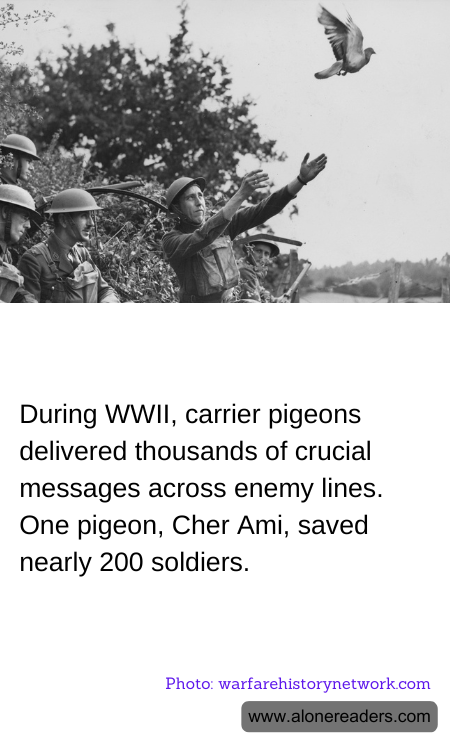
During World War II, carrier pigeons played a significant role in communications, particularly when traditional methods were disrupted or unsafe. These birds, valued for their speed, endurance, and navigational abilities, were often deployed to transport important messages across hostile territories. Among these avian heroes was Cher Ami, a pigeon whose actions exemplify the critical role these animals played in saving human lives.
Cher Ami was a Black Check cock pigeon, one of the many birds used by the U.S. Army Signal Corps in France during the war. He is most famously associated with the rescue of the "Lost Battalion" of the 77th Division, which had been isolated behind enemy lines in the Argonne Forest. In October 1918, over 500 men were surrounded with no means of communication to the outside world, as their radios had been destroyed and other pigeons had been dispatched only to meet their demise.
Carrying the final desperate note from Major Charles Whittlesey, Cher Ami was released into the sky, dodging gunfire and facing harrowing conditions. The message he carried was simple yet urgent: "We are along the road parallel to 276.4. Our own artillery is dropping a barrage directly on us. For heaven's sake, stop it." Despite being shot through the breast, blinded in one eye, and covered in blood, Cher Ami managed to reach his loft at division headquarters 25 miles away in just 25 minutes.
Cher Ami’s determined flight and the delivery of the message led to the rescue of about 194 men, preventing further casualties from friendly fire and ensuring that a relief party could reach the stranded soldiers. For his gallantry, Cher Ami was awarded the French Croix de Guerre with palm, and his feat was widely recognized as a symbol of perseverance and the vital role of carrier pigeons in wartime communications.
After the war, Cher Ami became a symbol of peace and bravery. The pigeon received extensive medical treatment, including a wooden leg to replace the one he had lost. Following his death in 1919, Cher Ami was preserved and now resides at the Smithsonian Institution's National Museum of American History, serving as a poignant reminder of the sacrifices and contributions of animals in human conflicts. His legacy highlights not only the intelligence and capability of pigeons but also the diverse methods of warfare employed during World War I, illustrating a unique aspect of military history where animals provided crucial support.