More About This Card
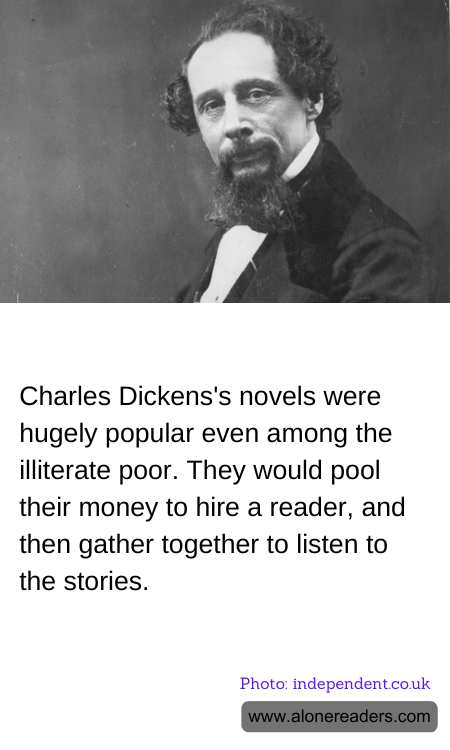
Charles Dickens, one of the most celebrated novelists of the Victorian era, wielded a profound influence that extended far beyond the literary elite. His novels transcended the boundaries of class and education, captivating not only the well-read middle and upper classes but also the illiterate poor. This intersection of literature and social culture during the 19th century highlighted the universal appeal of Dickens's storytelling and the communal spirit it fostered among his diverse audience.
The phenomenon of communal reading was particularly notable among the poorer sections of society, who, despite their inability to read, were eager to engage with Dickens’s vivid narratives of social justice, moral struggle, and character triumphs. Due to economic constraints and high rates of illiteracy, accessing literature was not a private affair but a communal endeavor. It was common for those who could not afford their own copies of Dickens’s novels, or who could not read, to pool their resources to hire a reader. These hired readers would recite the serialized segments of novels in public or semi-public spaces like taverns, workshops, or homes, transforming storytelling into a theatrical experience shared by a captivated audience.
This shared experience was not merely an entertainment practice but a vital social interaction within the community. Listening to Dickens's works in groups helped to instill a collective consciousness and offered a form of cultural and political education. His stories often explored themes of social reform—a topic that resonated well with the working class—and discussed the implications of industrialization, poverty, and class disparity. In an era when the personal experience of such issues was common, Dickens's narratives offered not only escapism but also a lens through which to view and critique one's own circumstances.
Moreover, this communal listening played a critical role in the era's social movements by informing and uniting the lower classes. As listeners were drawn into Dickens’s world, they were also being subtly equipped with the language and ideology to question the status quo and advocate for change. Hence, Dickens did not merely entertain; he stirred a consciousness that contributed indirectly to the social reforms of the time.
Today, the legacy of Dickens's influence on various social strata offers a fascinating look into how literature can serve as both a reflection of societal inequalities and a catalyst for social cohesion. Despite the evolution of literary consumption over centuries—from communal readings to digital audiobooks—the fundamental human desire to experience and share stories, much like in the days of Dickens’s communal readings, remains unchanged.