More About This Card
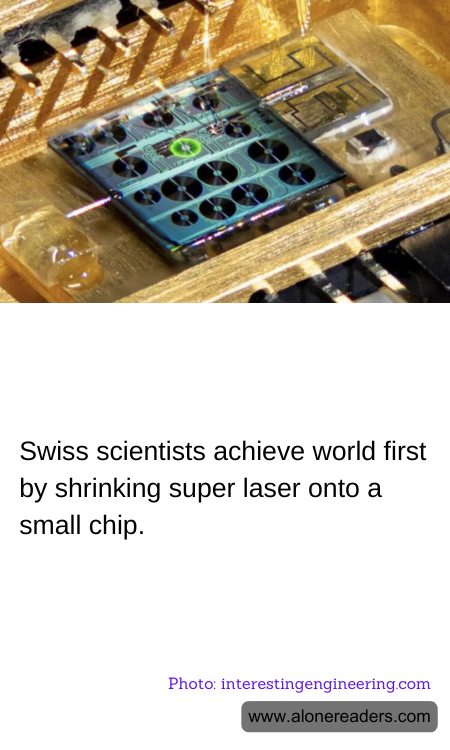
In an extraordinary leap in technology, Swiss scientists have managed to compress the power of a super laser onto a minuscule chip, marking a world-first achievement that may revolutionize various industries, from telecommunications to medical diagnostics. This groundbreaking innovation was led by a team from the Swiss Federal Institute of Technology (EPFL), renowned for its advanced research in photonics and quantum sciences.
Traditionally, high-powered lasers require large, energy-intensive setups with intricate arrangements of mirrors and lenses to focus and amplify light. However, this new technology bypasses the need for such bulky equipment by employing novel materials and cutting-edge nano-fabrication techniques. By embedding tiny, engineered structures that can manipulate light at the nanoscale, the team has succeeded in creating a chip-sized device capable of generating and controlling high-intensity laser beams.
The core breakthrough lies in the use of a highly specialized material that exhibits superior optical properties while being amenable to integration with existing semiconductor technologies. This allows the laser to be not only incredibly small but also efficient and versatile in its applications. For instance, the integration of such powerful lasers on chips could lead to more precise and less invasive surgical tools, as well as dramatically faster data transmission speeds for global communication networks.
Moreover, this innovation opens new avenues in scientific research, particularly in the fields of spectroscopy and quantum computing, where the manipulation of light at such small scales can be fundamentally transformative. In spectroscopy, this could enhance the detection of chemicals and biomarkers, making it more accurate and far-reaching, potentially facilitating earlier diagnoses of diseases. In quantum computing, the precise control of light is crucial, and by drastically reducing the size of lasers, the EPFL team may have significantly accelerated the path toward practical, scalable quantum computers.
The potential benefits of this technology extend further into areas such as environmental monitoring and defense, where high-powered lasers can be used for remote sensing and in space technologies. Its compact size and reduced power requirements make it ideal for deployment on satellites and other spacecraft, providing critical capabilities for Earth observation and beyond.
As industries and researchers around the world begin to explore the implications of this Swiss breakthrough, the miniaturization of super lasers onto chips stands as a testament to the incredible advancements being made in the field of photonics. This achievement not only showcases the ingenuity and forward-thinking of the Swiss scientific community but also sets the stage for a new era of technological innovation across multiple global sectors.