More About This Card
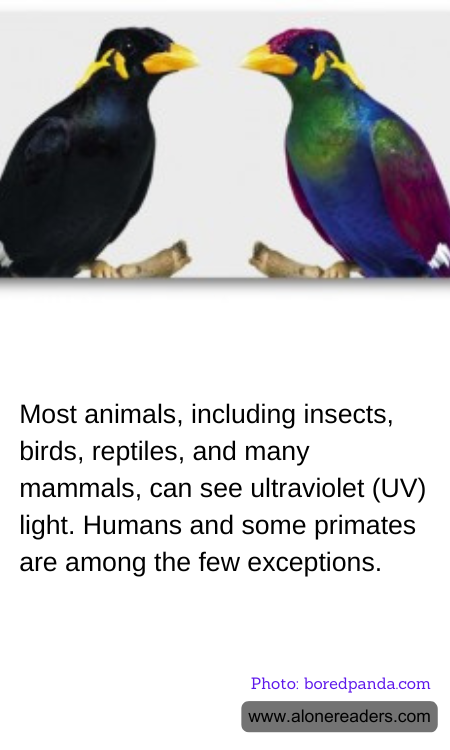
The ability to see ultraviolet (UV) light is a fascinating facet of the animal kingdom, prevalent among insects, birds, reptiles, and many mammals. This capability offers these animals significant advantages in navigation, prey detection, and communication. UV vision allows birds to see patterns on flowers that are invisible to the human eye, guiding them to nectar sources vital for their diet. This same ability helps birds during flight navigation, as they can detect the UV light reflected from the Earth's atmosphere, aiding their directional orientation.
Insects, particularly bees, exploit their UV vision for better identification and selection of flowers, enhancing their efficiency in pollination. The patterns seen in UV light on flowers often direct the bees to the nectar source, which is critical for the plant's reproductive cycle. Some insects, such as certain butterflies, utilize UV light to communicate sexual signals, thus playing a significant role in mating rituals.
Reptiles use UV light to regulate their body temperature more effectively, as many can detect the subtle differences between sunlit and shaded areas. This ability helps them to properly thermoregulate, which is essential for metabolism and activity levels. Some reptiles have patterns on their skins that only appear under UV light and these may play roles in social interactions and mating.
The ability to see UV light among mammals is less common but not absent. Some rodents and bats possess UV vision, which aids in foraging, especially under low light conditions. This can be crucial for survival, as it allows these animals to find food sources that would otherwise be hidden.
Contrastingly, humans and most other primates lack this UV seeing capability. The lens of the human eye blocks UV light, which on one hand protects the retina from potential damage, but on the other hand limits our spectrum of visible light. The evolutionary path of primates developed differently, possibly because the ability to see finer details at longer distances was more advantageous than UV vision in their early environments.
The diversity of UV vision in the animal kingdom underscores the vast range of evolutionary adaptations that have occurred. Each adaptation to UV vision offers specific survival benefits, shaped by the ecological needs and challenges faced by different species. This capacity adds yet another layer to the intricate and interconnected web of life, illustrating the complex and multifaceted ways in which evolution crafts the senses to fit an organism's environmental niche.