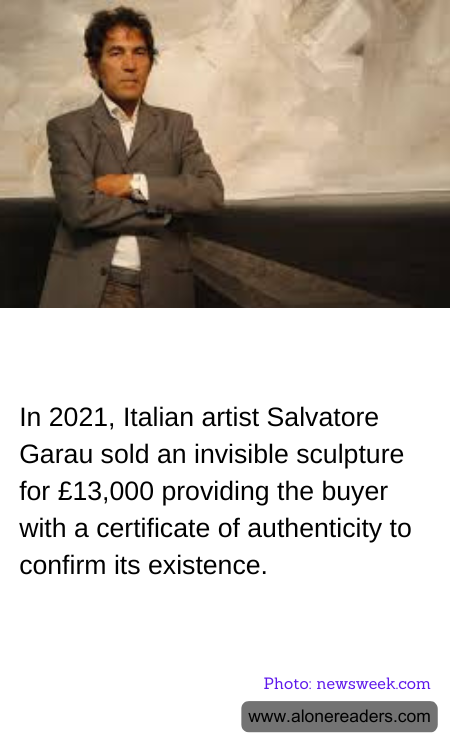
In a fascinating blend of art and imagination, Italian artist Salvatore Garau has taken the art market by surprise. In 2021, Garau sold an artwork that was quite literally out of sight, because it was an invisible sculpture. The piece, titled "Io Sono" (I Am), was purchased for £13,000. This peculiar transaction involved nothing tangible except a certificate of authenticity provided by Garau to the buyer, which is intended to confirm its existence.
Garau's work pushes the boundaries of what is traditionally considered to be 'art'. According to him, the sculpture exists but just not in material form, and is actually more about the concept than the physical object itself. The artist argues that this work of art isn’t nothing, but is instead a vacuum. Garau believes that the vacuum is nothing more than a space full of energy, and even if we empty it and there is nothing left, according to the Heisenberg uncertainty principle, that ‘nothing’ has a weight. Therefore, it has energy that condenses and transforms itself into particles, in short, into us.
When it came to displaying "Io Sono", the invisible sculpture was to be showcased in a square meter space free from any obstruction, with the area wherein the sculpture 'existed' demarcated by tape on the floor. Reflecting on his artistic intentions, Garau states that the piece focuses on its surroundings and the environment, emphasizing how the work interacts with the space around it.
Despite its intangible nature, the sale sparked considerable interest and debate about the nature of art and the function of the artist's intent. Some critics dismiss such art as pretentious or mocking, while others uphold it as a profound inquiry into the nature of creativity and the power of suggestion. This sale has brought attention to conceptual art—art that is meant to engage thought rather than the senses.
Garau's invisible sculpture challenges the conventions of visual art and engages viewers in a deep, abstract contemplation about existence and emptiness, pushing the age-old question of what art is, and what it could be, into new realms. This bold move has not only shaken the foundations of traditional art sales but has also opened up discussions on the intrinsic value and recognition of artistic expression in its most ethereal form.
