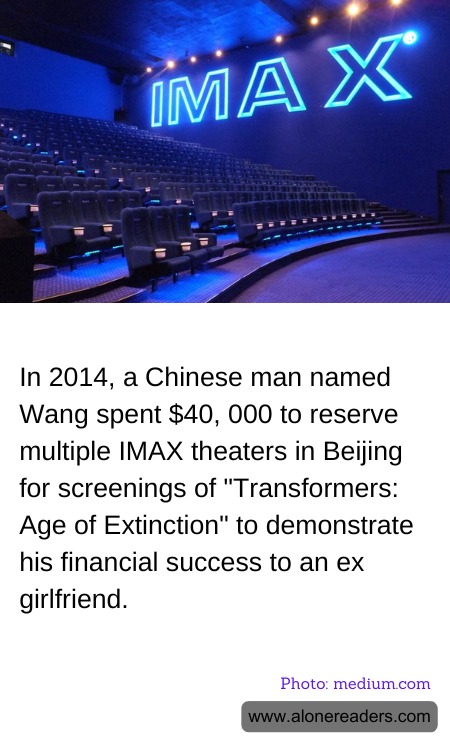
In an extreme display of lavish spending and questionable romantic gestures, in 2014, a Chinese man named Wang took an unconventional approach to showing his financial success to an ex-girlfriend by spending a staggering $40,000 to reserve multiple IMAX theaters in Beijing. His plan? To host screenings of the movie "Transformers: Age of Extinction". This act was not just about flaunting wealth, but also a unique, albeit excessive, attempt to perhaps impress or win back his former love.
The story quickly became a hot topic, sparking debates and discussions on social media and in various news outlets about the lengths to which some individuals will go to prove their financial capabilities or perhaps to seek revenge in the guise of success, post-breakup. Wang's theatric gesture throws into relief the broader cultural context in China, where economic success is often tightly interwoven with social status and personal worth. This growing trend sees people going to great lengths to showcase their wealth, especially amid the burgeoning middle and upper classes in urban centers.
While Wang's story might appear as an outlier in terms of the scale and the public nature of the gesture, it points to the increasing pressures and expectations related to financial success and romantic conquest in modern society. Interestingly, the choice of the movie "Transformers: Age of Extinction", a film full of spectacle and transformation, could symbolically parallel Wang's own desire to transform his past relationship or perhaps his personal status in the eyes of his ex-girlfriend and society at large.
Regardless of Wang's true intentions—whether it was to impress, reconnect, or merely showcase his financial prowess—the episode highlights intriguing intersections of love, status, cultural expectations, and modern economic power in contemporary Chinese society. It serves as a stark reminder of how dramatically economic success can be broadcast as a marker of personal value and romantic eligibility in today's world.
