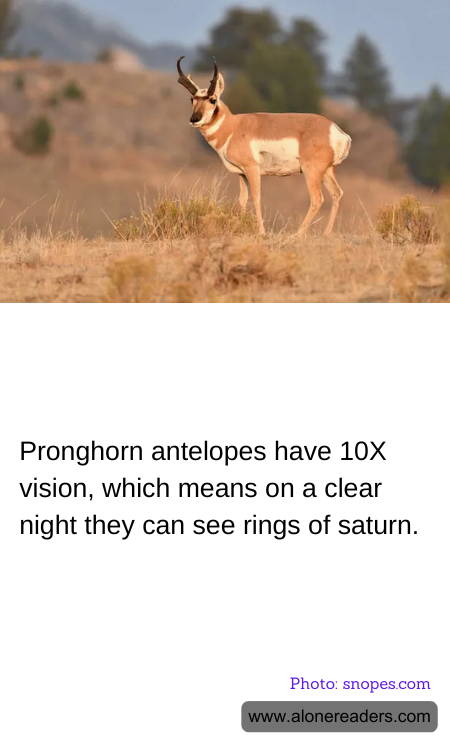
Pronghorn antelopes, native to the grasslands of North America, are remarkable creatures not just for their speed but also for their exceptional vision. Known to be the second-fastest land mammal, they also possess an extraordinary ability in their eyesight. The pronghorn's vision is so acute that it's often compared to having natural binoculars; they are said to have 10X vision. This means that what a human can see clearly at 10 feet, a pronghorn can see with the same clarity from 100 feet away.
This incredible visual capability is an evolutionary advantage that helps them spot predators like coyotes and bobcats from great distances. The clarity and range of their vision mean that on a clear day, pronghorns can discern fine details across several miles. However, the idea that they can see astronomical objects like the rings of Saturn with the naked eye is more of a hyperbole used to emphasize their powerful sight. While their vision is superior, spotting the rings of Saturn, which are over 746 million miles away from Earth, is beyond the capabilities of any terrestrial wildlife; such a feat generally requires a telescope with significant magnifying capabilities.
Despite this, the pronghorn's vision is indeed a marvel of nature, perfectly suited to the open plains where visual clarity can mean the difference between life and death. Their eyes are placed high on their skulls, giving them a wide field of view, which is essential for spotting threats and navigating their environment. This evolutionary trait highlights the incredible adaptations of pronghorn antelopes, making them one of the most fascinating creatures of the American wilderness. Their ability to detect movement and subtle differences in the landscape while traveling or grazing helps them avoid danger and communicate effectively with one another.
Understanding the precise capabilities and limitations of pronghorn vision not only fascinates those interested in wildlife but also provides valuable insights into how animals evolve traits necessary for survival in their specific habitats. The pronghorn's exceptional vision is just one of many adaptations that these intriguing animals use to thrive in their natural surroundings.
