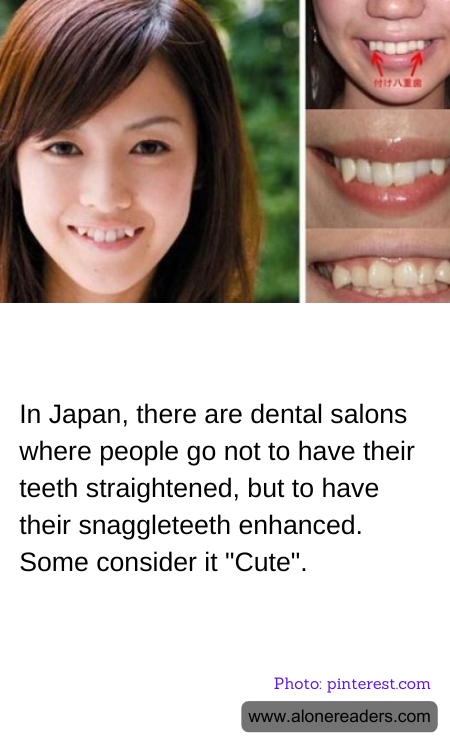
In Japan, a unique trend known as "Yaeba" has taken the beauty and dental industries by storm, with some individuals choosing to enhance their naturally uneven teeth to achieve a distinctively youthful and adorable look. Unlike Western beauty standards where a perfect, straight, white smile is often sought after, the Yaeba trend celebrates the charm of slightly crooked teeth, particularly the canines. This trend is particularly popular among young women who find that the slight dental imperfection can give a more approachable and childlike appearance, thereby enhancing their cuteness.
Dental salons across Japan have adapted to this trend by offering specialized services to artificially create the Yaeba effect. This can involve applying temporary or semi-permanent caps to the teeth to give them a more pronounced, fang-like appearance. The procedure is quick, reversible, and widely regarded as a safe form of cosmetic dentistry. This is markedly different from more invasive and permanent dental procedures such as braces or veneers frequently seen in the West.
The prevalence of Yaeba in Japanese culture can also be traced back to the influence of Japanese pop culture. Many idols and pop stars sport this look, further embedding the aesthetic into the desirability of mainstream beauty standards. Magazines, advertisements, and television shows often display models and celebrities with Yaeba, reinforcing its appeal among the younger demographic.
Culturally, the craze over snaggleteeth signifies a broader appreciation of imperfection within Japanese society known as "wabi-sabi." This concept finds beauty in the imperfect and transient nature of the world, which can be starkly different from the relentless pursuit of perfection seen in other parts of the globe. This mindset allows people to celebrate individuality and uniqueness, even in a smile.
Despite its popularity, Yaeba is not without its critics. Some dental health professionals warn that artificially modifying the teeth can lead to alignment issues or oral health problems later on. Moreover, as global beauty standards continue to evolve, there’s ongoing debate about the impact of such trends on societal perceptions of beauty and self-worth. Nonetheless, the phenomenon of Yaeba highlights how beauty ideals can vary greatly across different cultures, reflecting broader values and traditions unique to each society.
