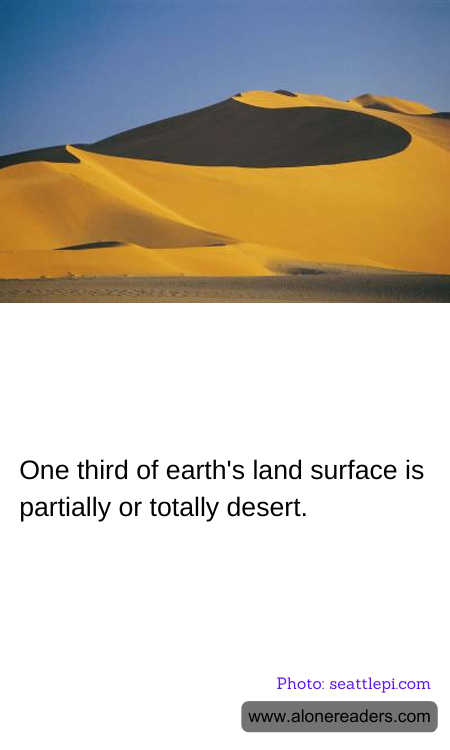
Deserts are vast, arid landscapes that make up about one third of the Earth's terrestrial surface. These regions are defined by their significant lack of precipitation, receiving less than 50 centimeters of rain per year, and by their extreme temperatures, which can vary widely from day to night. While the popular image of a desert often includes endless sand dunes, deserts can also appear as rocky plateaus, gravel plains, salt flats, and shrublands, displaying a remarkable diversity in their geological and ecological compositions.
The distribution of deserts is primarily found across regions that fall within specific latitude belts on the globe. In these zones, prevailing weather patterns and geographical settings contribute to the low humidity and scarce rainfall. For example, the Sahara Desert in North Africa, the largest hot desert in the world, exists under the influence of the subtropical ridge where dry air descends. Other notable deserts include the Arabian Desert in the Middle East, the Gobi Desert in Asia, and the Great Basin Desert in North America.
Deserts are more than just barren wastelands; they host unique ecosystems adapted to the harsh environment. Vegetation, where it occurs, is typically sparse and includes hardy species like cacti in the Americas, acacia trees in Africa, and spinifex grasses in Australia. Fauna too is intriguingly adapted to desert life. Creatures like the fennec fox, with its oversized ears for heat dissipation, or the camel, which can survive long periods without water, showcase evolutionary ingenuity.
Moreover, deserts play significant roles beyond their ecological characteristics. Historically, they have been corridors of trade and culture, as seen with the Silk Road across Central Asia. Today, they are important for mineral extraction and offer potential for large-scale solar energy harvesting due to their vast open lands and high solar irradiance.
Climate change, however, poses new threats to these fragile ecosystems. Alterations in temperature and precipitation patterns could expand desert areas, impacting biodiversity and exacerbating land degradation and desertification. This presents further challenges for the human populations living in or near deserts, often some of the most marginalized communities globally, who depend on such environments for their livelihoods.
Despite the harsh conditions, deserts remain critical to understanding ecological resilience and climatic interactions. Protecting these landscapes and the life they harbor is essential not only for conserving biodiversity but also for learning about sustainable living in extreme conditions, which is likely to be increasingly relevant as global climate scenarios evolve.
