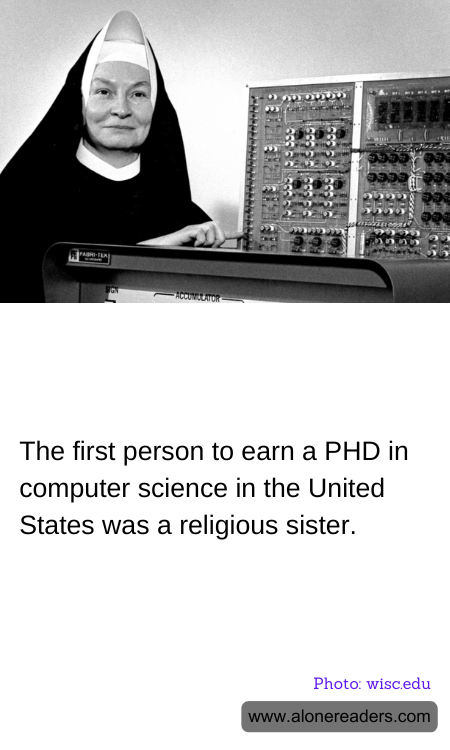
In the world of academic achievements and pioneering milestones, one story that stands as a beacon of inspiration is that of Sister Mary Kenneth Keller. Born in 1913, Sister Keller was a woman of profound intellect and unwavering dedication, which led her to become the first person in the United States to earn a PhD in computer science. Her groundbreaking achievement not only shattered the conventional boundaries associated with women in the sciences, especially in the male-dominated tech field but also spotlighted the unique pathway she carved out as a Catholic nun.
Sister Keller embarked on her educational journey at a time when computer science was just emerging as a distinct field of study. She entered the religious order of the Sisters of Charity of the Blessed Virgin Mary in 1932 and soon recognized the potential of technology in education. Her pursuit of higher education in the field led her to the University of Wisconsin, where she earned a B.S. in Mathematics, and later, advanced degrees from the University of Michigan and Purdue University.
However, her most significant academic achievement was at the University of Wisconsin, where she participated in the development of the computer language BASIC while completing her PhD. BASIC was instrumental in making computers accessible to a broader base of users, reflecting her deep-rooted belief that technology should serve people, and not the other way around.
Dr. Keller’s career following her PhD reflects her commitment to education and accessibility. She founded the computer science department at Clarke College in Iowa, where she also encouraged women to enter the field, long before the conversation around women in STEM gained mainstream attention. Her work extended beyond academic instruction, involving advocacy for wider access to computers and the importance of using technology to improve education.
Sister Keller’s legacy extends much further than her academic and professional accomplishments. She left behind an indelible mark on how computer science developed as a discipline and how it continued to evolve to become a crucial part of educational curricula across the world. Moreover, her life is a testament to the impact of women in technology and the potential of educational inclusivity.
Sister Mary Kenneth Keller passed away in 1985, but her pioneering spirit in the realm of computer science continues to influence and inspire countless individuals across gender, vocational, and religious lines, illustrating the profound impact that one dedicated individual can have on the technological landscapes of the future. Her blend of spiritual commitment and scientific inquiry challenges the stereotypical narratives around both fields, offering a story of unity and mutual enrichment between faith and reason, religion and STEM.
