More About This Card
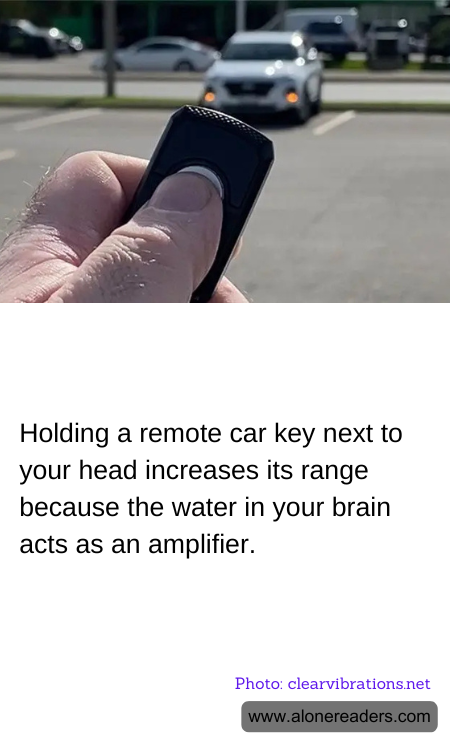
Have you ever found yourself in a large parking lot, struggling to remember where you parked your car? A common trick that many people use to locate their vehicle more easily involves holding their remote car key to their head while pressing the button. Surprisingly, it often seems to work, extending the key fob’s signal range. But what’s the science behind this phenomenon?
The primary reason this trick works is not exactly about the water in your brain acting as an amplifier, but rather it's due to using your head as a makeshift antenna. The human skull, with its water content and its relatively spherical shape, can help to modify the signal emitted by the key fob. When you press the car key while holding it to your head, radio waves traveling from the fob are helped by the conductive properties of the fluids in your head. Essentially, these fluids help to extend the electromagnetic waves further than they would typically travel when the key fob is held at waist level.
This works because radio waves spread out from the antenna (in this case, the car key fob) and can be reflected, refracted, or absorbed by different materials. The human body, being largely composed of water, has a slight conductive capability which makes it a decent transmitter of electromagnetic waves. When you hold your car key fob to your head, you increase the height and change the position of the antenna, which tends to allow the radio waves to travel over a greater distance and might also prevent the signal from being as easily blocked by other cars or objects.
Physics aside, this trick could potentially increase the effective range of the car key fob’s signal by a small amount, though the extent of the increase will likely vary based on the specific environment and other factors such as the specific design of the key fob and the responsiveness of the car’s receiver system.
However, it’s interesting to note that while this method might offer a slight improvement in range, it’s not without its skeptics who question the safety and effectiveness of the technique. Though, there’s no denying that many people continue to find success in using their head—quite literally—as a helpful tool in locating their cars. Whether due to the placebo effect or a slight boost in the signal’s range thanks to the conductive properties of the human body, this urban myth continues to hold a place in the curious practices of car owners around the world.