More About This Card
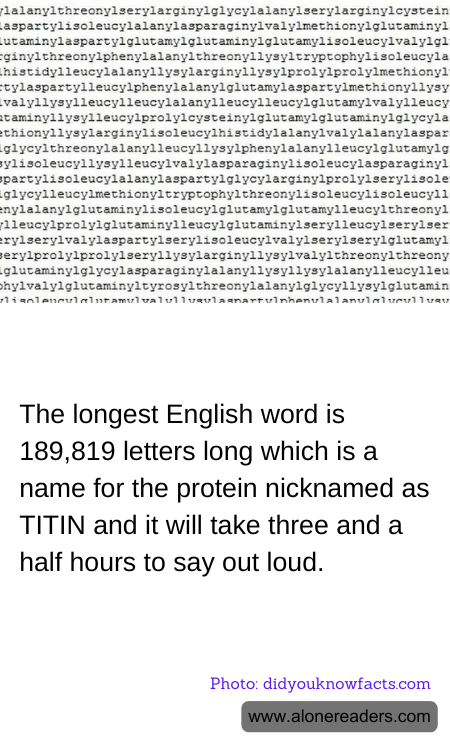
One of the most fascinating aspects of the English language is its capacity to form exceptionally long words, especially in the domain of science. The longest word encompasses a staggering 189,819 letters, and it is the chemical name for the protein commonly known as titin. Titin, an essential element in the functioning of muscular tissue, holds the distinction not only for its size at a molecular level but also for its lexical length.
The full name for this giant protein is rarely used, primarily due to its impractical length. It is often abbreviated to simply 'titin' for ease. Titin serves as a molecular spring which is responsible for the passive elasticity of muscle. It is not just the largest protein but also one with a significant role in the biomechanical properties of tissues.
The pronunciation of the full chemical name of titin is a marathon task in itself. It takes about three and a half hours to articulate aloud, a challenge that few have undertaken. This word surpasses others by far in length, including famously long medical terms or those created for the sake of novelty.
The existence of such a word underscores not just the complexity of biological structures, but also the intricacies of the language used to describe them. It also illustrates the playful and sometimes unwieldy intersections of language, science, and mathematics, where descriptors are created to encompass a detailed understanding of molecular structure in a single term. However, due to the word's extraordinary length and impracticality, it primarily remains a fascinating piece of trivia in the realms of linguistics and biochemistry, mentioned more for its novelty than for everyday use in scientific discourse.