More About This Card
Deep in the heart of Malheur National Forest in eastern Oregon lies a remarkable, yet not widely known giant. The "Humongous Fungus," a massive organism of the species Armillaria ostoyae, or more commonly known as the honey mushroom, covers an astonishing area of 3.7 square miles, which is about 1,665 football fields. This gigantic organism is not only considered the world's largest living organism by area but is also one of the oldest, estimated to be thousands of years old.
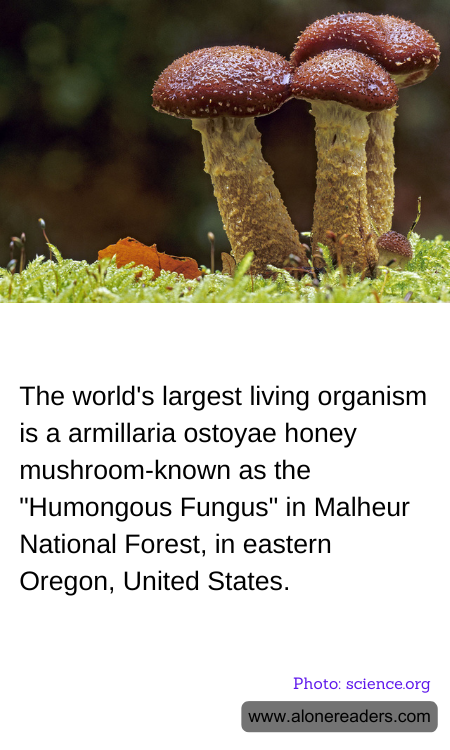
The Humongous Fungus thrives just beneath the forest floor, where its sprawling network of mycelial threads called rhizomorphs spread out far and wide, seeking nutrients and colonizing tree roots. On the surface, the only visible signs of this gargantuan life form are clusters of golden mushrooms that appear during the fall. These mushrooms are the fruiting bodies of Armillaria ostoyae and are integral to its reproductive process. During this period, the fungus spreads spores which are carried by the wind, allowing it to propagate and maintain its vast subterranean presence.
What makes Armillaria ostoyae particularly fascinating is its mode of growth and survival. It is both a pathogen and a decomposer. As a pathogen, it infects forest trees by penetrating their root systems, ultimately causing disease and decay. As a decomposer, it breaks down the dying or dead trees, recycling nutrients back into the ecosystem. However, the size and impact of the Humongous Fungus are a double-edged sword; while it plays a critical role in the forest’s ecological balance by decomposing wood, its pathogenic nature can threaten the health of the forest, posing challenges to forest management and biodiversity.
The discovery and ongoing study of the Humongous Fungus have provided invaluable insights into fungal ecology and forest dynamics. Scientists continue to study its impact on the forest ecosystem, exploring both its destructive tendencies and its vital role in nutrient cycling and forest regeneration. Moreover, this organism has stirred curiosity and fascination not just among mycologists and ecologists but also among the general public, highlighting the hidden complexities and wonders of fungal life.
In conclusion, the Humongous Fungus in Oregon is a stunning example of the mysteries and marvels of nature. It challenges our conventional views of what an organism can be and serves as a powerful reminder of the intricate connections that sustain and regulate our natural world. Whether viewed as a behemoth or a benefactor, this fungal giant continues to be a subject of awe and scientific exploration.