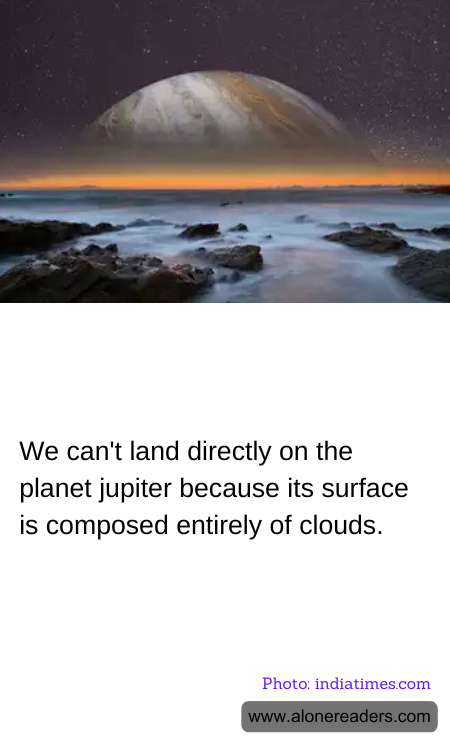
Jupiter, the largest planet in our solar system, presents an inhospitable environment for landing missions similar to those conducted on solid celestial bodies like the Moon or Mars. The main obstacle to landing on Jupiter is its lack of a true surface. The planet is composed almost entirely of hydrogen and helium, with no solid ground to speak of. What appears as the "surface" of Jupiter from a distance is actually a dense, deep atmosphere comprised of thick clouds of ammonia and other gases, extending thousands of kilometers deep.
This gas giant’s atmospheric conditions are extreme, with violent storms and winds reaching speeds of up to 620 kilometers per hour. The most famous of these storms is the Great Red Spot, a gigantic storm larger than Earth that has been raging for centuries. In addition to the fierce winds and storms, the atmospheric pressure on Jupiter increases so dramatically with depth that any spacecraft attempting to descend would be crushed long before reaching what scientists consider to be the core.
Moreover, Jupiter’s strong magnetic field creates high levels of radiation that are deadly to most modern spacecraft electronics. This radiation, along with the high gravity pull of the planet, would make a direct landing and departure incredibly challenging and currently beyond our technological capabilities.
Instead of attempting a landing on Jupiter itself, missions like NASA’s Juno probe, which began orbiting Jupiter in 2016, focus on remotely gathering data about the planet’s composition, magnetic field, and polar magnetosphere. Juno and other probes can study the planet from a safe distance, providing valuable information without the risks and technical impossibilities associated with a direct landing.
In summary, attempting to land on Jupiter is not feasible with today's technology due to its lack of a solid surface, extreme atmospheric conditions, immense pressure and temperature, and high levels of radiation. Our exploration of this gas giant continues from afar, using advanced robotics and remote sensing technologies to study and understand more about this massive planet and its many mysteries.
