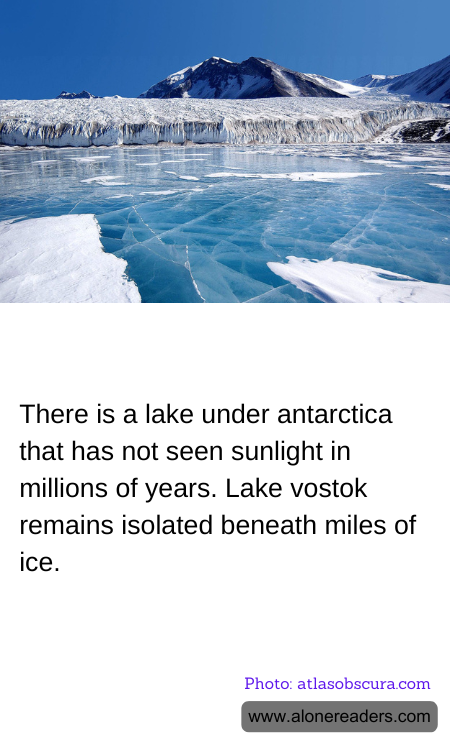
Buried beneath the icy expanse of Antarctica lies a remarkable body of water known as Lake Vostok, which has remained sealed off from the rest of the world for millions of years under a four-kilometer-thick ice sheet. This subglacial lake, discovered by Russian scientists, is one of the largest of Antarctica's almost 400 known subglacial lakes and has sparked significant scientific interest due to its extreme conditions and unique environment.
Lake Vostok is approximately the size of Lake Ontario and is believed to have been isolated from the atmosphere for around 15 million years. This isolation has created a unique ecosystem that remains untouched by human activity and external environmental factors, which might offer vital clues about life forms and climate conditions of the past. Moreover, the extreme conditions of the lake — including high pressure, constant cold, and complete darkness — provide a prime analog for extraterrestrial environments, particularly the icy moons of Jupiter and Saturn, which may harbor water beneath their own ice shells.
Scientific exploration of Lake Vostok has faced numerous challenges due to the harsh conditions and the need to prevent contamination of the pristine environment. The initial breakthrough occurred in 2012 when Russian scientists successfully drilled through the ice to the lake water, taking care not to contaminate it with drilling fluids. This was achieved by using a kerosene and freon mixture to prevent the borehole from freezing, which would withdraw from the borehole as lake water entered it, thereby avoiding direct contact.
The samples collected from these drilling expeditions have been studied to understand the types of microorganisms that have adapted to such extreme conditions. Preliminary findings have indicated the presence of thousands of species of extremophiles — organisms that thrive in extreme environments. These microorganisms could provide insights into the biochemical pathways of life forms that can exist without sunlight, which could have implications for our understanding of potential life on other planets.
Studying Lake Vostok not only enhances our understanding of Earth's biodiversity and climate history but also contributes to astrobiology and the search for extraterrestrial life. By examining how life adapts in such harsh conditions on Earth, scientists hope to gain insights into the possibilities of life beyond our planet, particularly in similar conditions that might exist on icy moons like Europa or Enceladus. Thus, Lake Vostok serves not just as a subject of earthly study but as a door to the broader mysteries of life in the cosmos.
