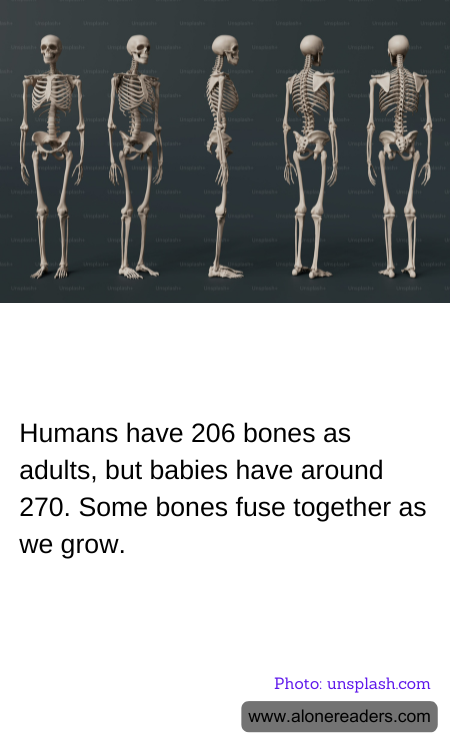
The human skeletal system is a marvel of biological engineering, consisting of a complex framework of bones that serve various critical functions, from providing structure and support to protecting vital organs. Interestingly, the composition of this framework changes from infancy into adulthood, reflecting a fascinating aspect of human developmental biology.
At birth, babies have approximately 270 bones, a number higher than that of an adult. This is primarily because infants have more cartilage, a softer and more flexible tissue. Cartilage plays an essential role during the early stages of development by allowing for growth and the formation of bone structure. As children grow, many of these cartilaginous structures gradually ossify, which is the process by which cartilage is replaced by bone, made possible through the deposition of minerals.
The reason behind the higher number of bones in infants is that many of their bones have not yet fused. For example, the bones in the human skull start as separate plates, allowing the skull to be flexible enough to pass through the birth canal. In the years following birth, these plates slowly grow together and fuse, a process that is largely completed by the age of two. This fusion is crucial for protecting the brain and supporting the facial structure.
Similarly, the spine of a newborn comprises 33 individual bones or vertebrae and will eventually fuse to form a more rigid backbone consisting of only 26 bones in adults. This transformation is part of the natural maturation process, allowing for an appropriate balance between structural support and flexibility needed to protect the spinal cord and support the body’s weight.
Furthermore, the number of bones in the hands and feet also decreases as small bones fuse together to form more robust and durable structures capable of handling more significant stress and strain. This adaptation is vital as it supports the various physical activities associated with human mobility and manipulation of the environment.
Understanding how our skeletal system transforms from a flexible framework of over 270 bones into a more solid, yet still somewhat flexible, structure of 206 bones is not just an academic curiosity. It's crucial for numerous medical disciplines, including pediatrics, orthopedics, and forensic science. Each phase of bone development plays a vital role in overall health and functionality, emphasizing the incredible adaptability and efficiency of the human body. Thus, our bones are not just the rigid protectors and supporters they are often thought to be; they are dynamic organs that evolve, adapt, and regenerate throughout our lives.
