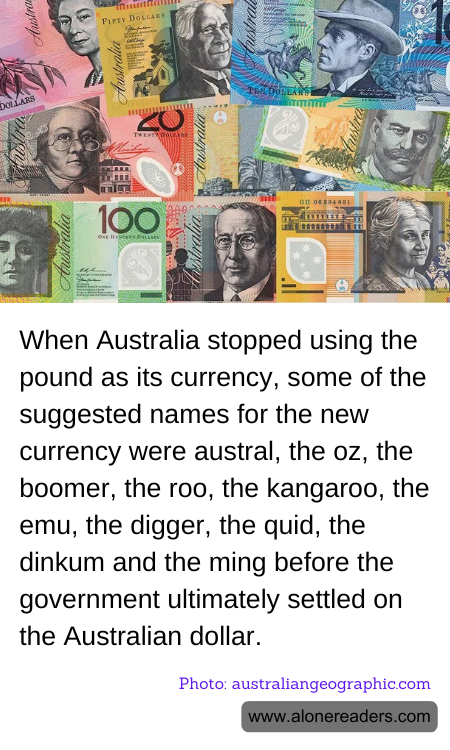
When Australia decided to move away from the British pound and establish its own currency in 1966, the process involved not just logistical changes but also a significant cultural shift. The renaming of the currency was seen as an opportunity to reflect the country's distinctive identity and independence. The names considered for the new currency were both imaginative and reflective of Australia's national symbols, fauna, and cultural heritage.
Among the proposed names were the "Austral," which suggests a connection to the southern hemisphere, and the "Oz," a colloquial abbreviation of Australia itself, evoking the magical and distinctive nature of the country. Wildlife was a popular inspiration, with names like the "Boomer" (short for Boomerang or a male Kangaroo), "Roo" (short for Kangaroo), "Kangaroo," and "Emu" reflecting Australia's unique fauna. Each name carried the potential to brand the currency with a uniquely Australian flair.
Other suggestions included the "Digger," a nod to the colloquial term for Australian soldiers, particularly those who served during World War I. The "Dinkum," derived from the phrase "fair dinkum" which is used to assert truth and genuineness, and even the playful "Quid," which was a slang term for the pound and represented continuity with the past. Another notable mention was the "Ming," derived from the nickname of then Prime Minister Robert Menzies, demonstrating the impact of political figures in public life.
Contrasting with these distinctly Australian terms was the suggestion of a name like the "Austral," which while less colloquially Australian, underscored Australia's geographical position in the southern hemisphere. The decision-making process ultimately favored a more straightforward and internationally recognizable name, leading to the choice of the "Australian Dollar." This choice ensured clarity and continuity in Australia's financial relationships while marking a new era of economic autonomy.
The diversity of names considered reflects the vibrant and multifaceted nature of Australian culture and the various aspects of national identity that resonate within the community. The shift to the Australian dollar was more than a change in currency; it was a declaration of Australia's burgeoning national identity, celebrating its independence and unique cultural and natural heritage. The choice of "Australian Dollar" may seem pragmatic compared to the other more colorful options, but it provided a clear and unambiguous symbol for Australia’s economic future.
