More About This Card
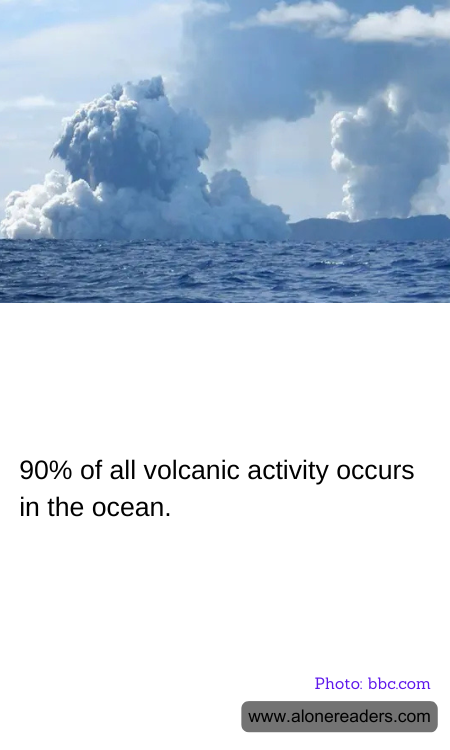
Volcanic activity is not only a spectacle on land but is even more prevalent beneath the ocean's surface, where it goes largely unseen. Remarkably, about 90% of all volcanic activity on Earth occurs in the ocean, contributing significantly to various geological and biological processes.
The majority of underwater volcanic activity happens along the mid-ocean ridges, which are massive mountain ranges extending across the ocean floor. These ridges mark the boundaries where tectonic plates are pulling apart, allowing magma from deep within the Earth to rise and cool, creating new crust. This process, known as seafloor spreading, plays a crucial role in the continual renewal and expansion of the ocean floor.
One of the most famous and active underwater volcanic areas is the Mid-Atlantic Ridge, which extends from the Arctic Ocean down to the southern tip of Africa. Another significant site of submarine volcanic activity is the "Ring of Fire," a horseshoe-shaped area in the Pacific Ocean that is a hotbed for earthquakes and volcanic eruptions, both underwater and on island arcs created by oceanic plates sinking beneath continental plates.
Submarine volcanoes can also form islands. For instance, the Hawaiian Islands were formed by a hotspot in the Earth's mantle, which remains stationary as the Pacific Plate moves over it. The hot magma rises through the crust and erupts underwater, eventually building up enough volcanic material to break the surface and form islands.
The interaction of magma and seawater creates unique environments and geological formations. Pillow lavas, for example, are formed when lava erupts underwater and quickly cools, forming rounded shapes reminiscent of pillows. These and other formations contribute to diverse habitats that support a wide range of marine life.
Moreover, submarine volcanic activity plays a crucial role in the Earth's carbon cycle. The interaction between the basalt of the ocean floor and seawater facilitates a natural process known as "chemical weathering," which captures and stores carbon dioxide, a significant greenhouse gas.
In conclusion, the oceans' hidden volcanic activity is a powerful force shaping not only the geography of the ocean floor but also the surface of our planet and its atmosphere. This undersea volcanic activity is crucial in understanding Earth's geological and ecological dynamics, highlighting the interconnectedness of Earth's systems, which, even when hidden beneath ocean waves, have profound impacts on the global environment.