More About This Card
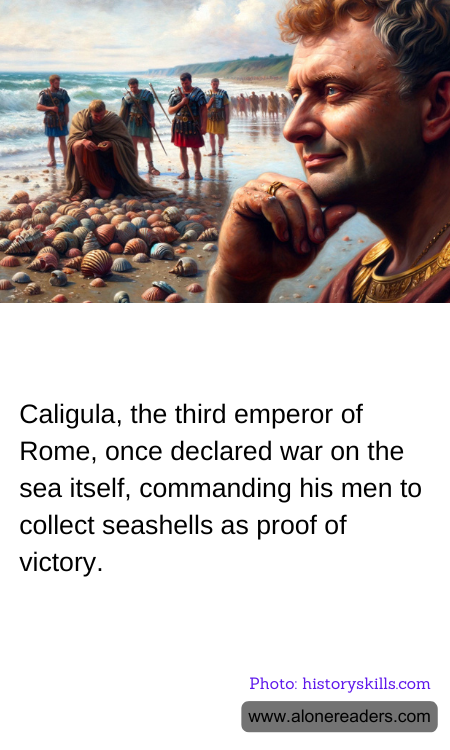
Caligula, born Gaius Julius Caesar Augustus Germanicus, is one of the most infamous figures in Roman history, epitomizing the excess and cruelty that at times characterized the imperial era. Ascending to power in AD 37 as the third emperor of Rome, he is widely remembered not just for his tyrannical rule over the Roman Empire, but also for his eccentric and bizarre actions, one of the most peculiar being his declaration of war on the sea.
The incident occurred during his campaign in the north of the Roman Empire, where Caligula decided to invade Britain. However, upon reaching the English Channel, he seemingly changed his mind under mysterious and unexplained circumstances. Some historians speculate that his decision might have been due to a sudden storm, the fear of an actual military defeat, or perhaps his unstable mental state.
Instead of launching an invasion, Caligula ordered his soldiers to engage in one of the most ludicrous military operations in history—collecting seashells along the shore. He framed these seashells as "plunder from the sea," evidence of his victory against the ocean, a supposed enemy. This act was either a demonstration of his divine power, as he claimed descent from the gods, or a way to mock his troops, possibly as punishment for perceived disloyalty.
Scholars have long debated the motivations behind Caligula's actions. Some view this episode as a testament to his madness, suggesting that he was suffering from an illness that impaired his judgment and perceptions of reality. Others interpret it as a calculated move to demean and demoralize his troops, thereby reaffirming his absolute power.
Regardless of his true intentions, this event vividly highlights the unpredictable and often surreal nature of Caligula's rule. It serves as a symbol of how unchecked power can lead to bizarre and irrational decisions. The "war on the sea" remains a fascinating anecdote within the broader and more brutal legacy of Caligula's reign, illustrating the unpredictable and often theatrical exercise of imperial authority in ancient Rome.