More About This Card
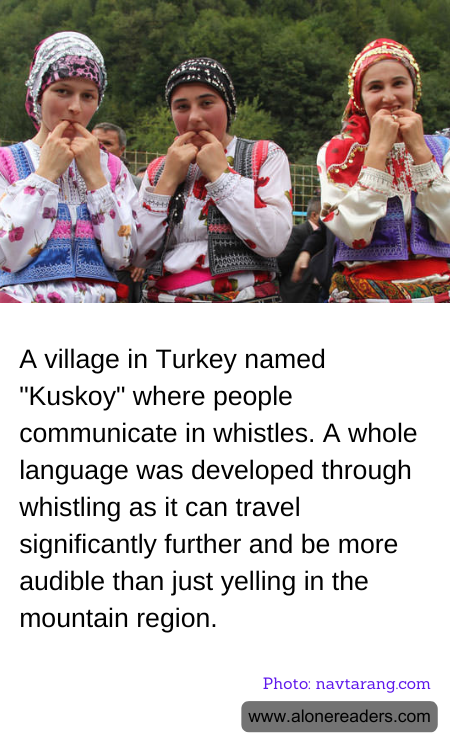
In the verdant, mountainous landscapes of northern Turkey lies a unique village named Kuskoy, which translates to "Bird Village." Here, residents communicate in a most extraordinary way—not through words spoken in the usual manner, but through whistles. This fascinating form of communication, known as "bird language" or "kus dili" in Turkish, is an adapted form of Turkish which has been developed into a whistled language.
This method of communication is not merely a cultural novelty but an ingenious adaptation to the challenging terrain of the region. The village is situated in an area of steep valleys and sharp mountains, where traditional methods of communication like shouting could be physically demanding and less effective. Whistling, on the other hand, allows messages to cut across vast distances, up to several kilometers, with relative ease. The high pitches of whistle tones make them more effective at traveling across wide valleys and dense forests, ensuring clear and swift transmissions of messages.
The linguistic mechanism involves the use of pitch and melody to convey the phonetic and prosodic elements of spoken Turkish, effectively transforming standard language syllables into distinctive whistled sounds. Every aspect, from greetings to everyday chatter, and even intricate details like exchanging news or arranging meetings, can be communicated through this whistled language. It is a fully functional linguistic system practiced by both young and old villagers, playing a pivotal role in community life.
However, the unique cultural heritage of Kuskoy faces challenges from modernization. As new technologies such as cell phones and the internet become commonplace, the practical need for whistle communication diminishes. The younger generation, drawn potentially more to urban opportunities, might not find learning or maintaining the whistle language as appealing or necessary as their ancestors did.
Recognizing the cultural and linguistic importance of the bird language, efforts are being undertaken to preserve it. Kuskoy's whistled language has been included in the UNESCO Intangible Cultural Heritage List, which has helped raise awareness about its significance and the need for its preservation. Local initiatives also aim to keep the tradition alive by teaching it in schools and promoting it through festivals and tourist activities that celebrate and showcase the unique linguistic practice to visitors.
The preservation of Kuskoy’s whistled language is crucial not only for maintaining the cultural identity of the village but also for the broader implications it holds for linguistic diversity and human ingenuity in adapting to environmental challenges. Through sustained efforts, Kuskoy continues to echo the sounds of its unique heritage, hoping to carry its whistles into the future.