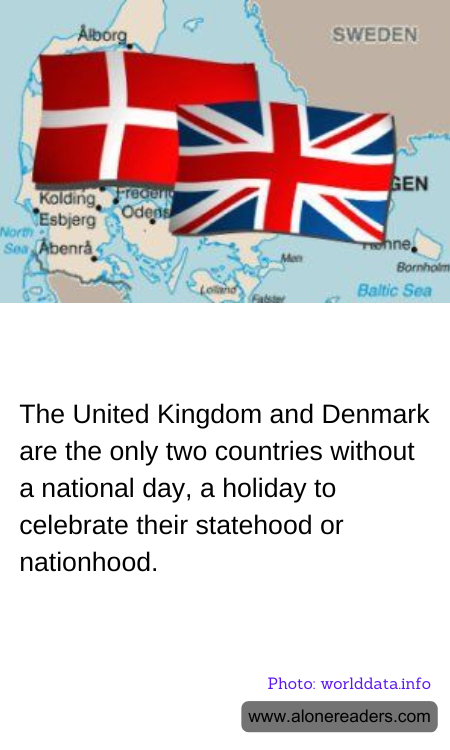
The concept of a national day, often marked by public holidays and festivities, is a prevalent phenomenon around the world. It commemorates the statehood or nationhood of a country, embodying a significant historical or cultural milestone. However, not all countries observe such a day. Notably, the United Kingdom and Denmark stand out as two countries without an official national day.
In the United Kingdom, the absence of a singular national day can be attributed to its composed nature of four countries — England, Scotland, Wales, and Northern Ireland — each of which has its own patron saint’s day: St. George's Day for England, St. Andrew's Day for Scotland, St. David's Day for Wales, and St. Patrick's Day for Northern Ireland. These days are celebrated to different extents across the UK. However, none of these serves as an official national day for the UK as a whole. The closest equivalent might be considered the Queen's Official Birthday, traditionally marked by the Trooping the Colour parade, which does not specifically celebrate national statehood but rather the monarchy, which has played a key role in British history.
Meanwhile, in Denmark, although there is no official national day, Constitution Day on June 5th comes closest to such a celebration. This day commemorates the anniversary of the signing of the Danish Constitution in 1849, which established Denmark as a constitutional monarchy. Despite its significance, Constitution Day is not characterized by the same level of pomp and nation-wide celebration typically associated with national days in other countries. Instead, it is observed with more understated events and political meetings, reflecting perhaps the Danish ethos of low-key, democratic celebration.
The absence of a national day in both the UK and Denmark might suggest a different approach to national unity and state-building than that of more centralized nations. In both cases, historical, political, and cultural factors contribute to how national identity and milestones are recognized and celebrated. For the UK, the complex relationship between its constituent nations and their individual identities plays a role, while in Denmark, the emphasis might be on democratic values and historical reforms rather than on the mere fact of nationhood.
Overall, the lack of a traditional national day in these countries does not diminish their sense of nationhood but reflects a different narrative of national identity, one less reliant on singular symbolic dates and more embedded in a broader historical-contextual framework. These distinctions offer a rich insight into how nations differently represent and celebrate their cultural heritage and political history.
